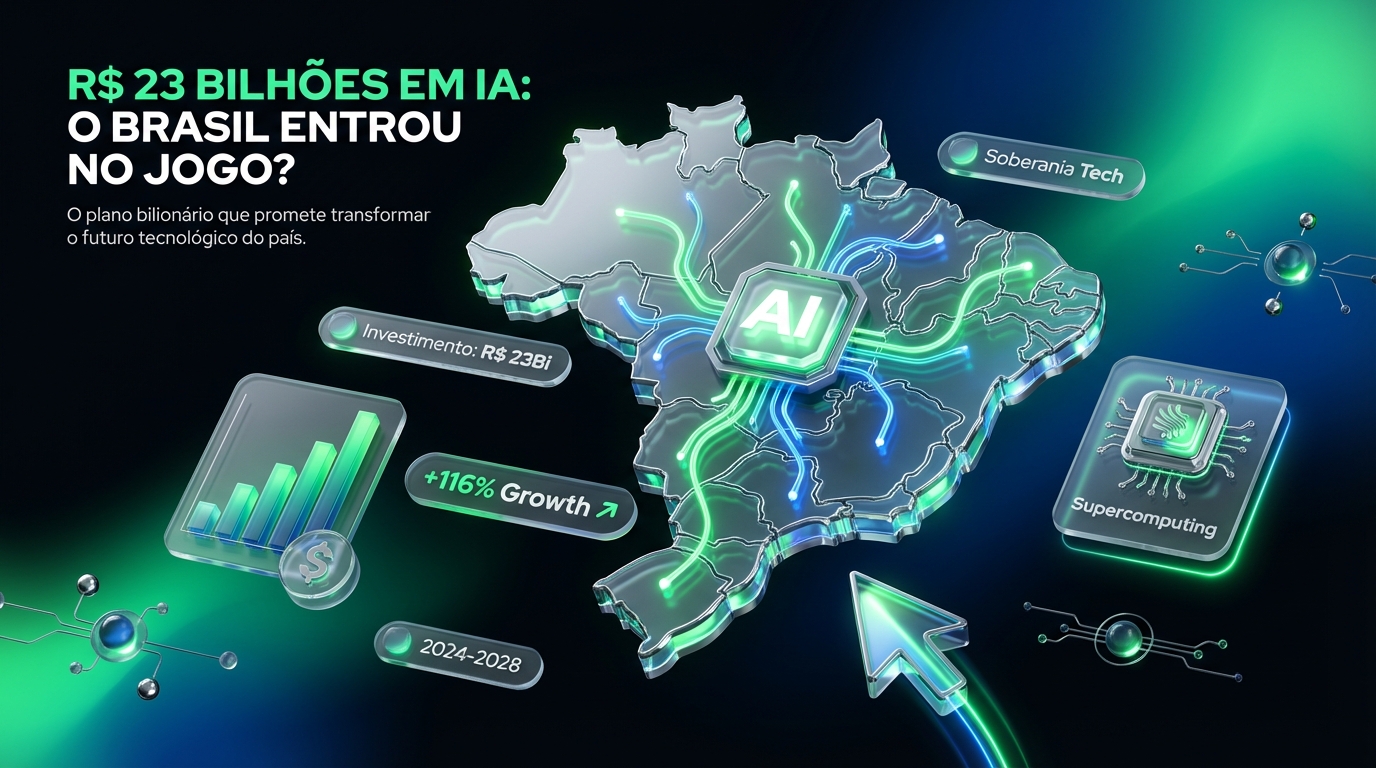
Brazil is on the cusp of an unprecedented technological transformation, driven by a massive investment in Artificial Intelligence. With a plan projecting R$ 23 billion by 2028, and an initial jump of R$ 267 million in ICTs in 2025—a 116% growth—the nation is positioning itself to redefine its technological sovereignty.
This strategic movement, led by the Brazilian Artificial Intelligence Plan (PBIA), aims for more than just modernization; it seeks to empower industry and the public sector to operate with an intelligence that transcends digital borders, directly addressing the pain of technological dependence and the operational inefficiency intrinsic to data silos.
What Happened
The Brazilian Artificial Intelligence Plan (PBIA) 2024-2028, launched in July 2024, details an ambitious allocation of resources. Of the total R$ 23.03 billion, approximately R$ 14 billion is destined for business projects—encompassing the AI value chain, national data centers, and support for startups and SMEs. Another R$ 5 billion will strengthen AI infrastructure, including 42 projects focused on sustainable energy for data centers, with the remainder focused on training, public services, and governance.
A central pillar is the National Supercomputer, which will receive R$ 1.8 billion (US$ 337 million) by 2027. The goal is to position Brazil among the world’s top 5 in processing capacity, allowing for the training of AI models with local data, which is crucial for sectors such as health, agriculture, climate, and security. Training is also a priority, with the creation of 5,000 undergraduate AI spots in three years and a 50% increase in the number of students in STEM courses within five years, ensuring that talent keeps pace with infrastructure. The private sector is already responding: Microsoft announced US$ 2.7 billion in cloud and AI in Brazil, and companies like Eletrobras have signed strategic partnerships for modernization.
The Alchemist’s Analysis
Here at Centrato AI, we observe these investments with the rigor of an alchemist: transforming raw resources into functional intelligence requires more than just a capital injection. The promise of a national supercomputer and billions in AI infrastructure is seductive, but the true alchemy lies in the ability of your operation to absorb and capitalize on this intelligence.
Why “multi-agents” is the future and a single agent is just a toy?
The great risk is that, instead of building a cohesive intelligent system, companies end up with a myriad of isolated AI “agents”—point solutions that do not communicate, do not share data, and do not orchestrate results. A chatbot here, a predictive analysis there, without a connective tissue to transform them into systemic intelligence.
Technological sovereignty is not achieved through national infrastructure alone; it begins with the operational maturity of each company. If your organization still deals with insurmountable data silos, repetitive manual processes, and a culture averse to intelligent automation, even the most powerful supercomputer in the world will become just an expensive tool to automate chaos. It will be capable of training incredible models, but the ability to apply these models in an integrated and strategic way—optimizing workflows and making informed decisions in real-time—will fundamentally depend on your data architecture and organizational culture. To be truly transformative, artificial intelligence needs to be a “multi-agent” system operating in harmony, not a set of isolated “toys.”
Impact on Operations
For the industrial and tech director, the PBIA is not an abstraction; it is a catalyst for profound operational changes.
- Data Security and Sovereignty: With national data centers and local processing capacity, companies can reduce dependence on foreign infrastructure, ensuring greater control and security over sensitive data, especially in regulated sectors. This mitigates geopolitical and compliance risks.
- Governance and Compliance: National infrastructure imposes the need for more robust internal data governance standards. The ability to train models with local data requires that this data be clean, accessible, and compliant, raising the bar for information management.
- Intelligence Orchestration: Access to locally trained models opens doors for customization at scale. However, the real challenge lies in orchestrating the application of these models across multiple processes. The smart factory of the future will not have a single “AI-agent,” but rather an orchestra of autonomous and semi-autonomous systems, from supply chain optimization to predictive maintenance and quality control. The ability to manage and integrate these “multi-agents” will be the competitive differentiator.
Conclusion
Brazil is undeniably making its boldest bet on Artificial Intelligence. The injection of R$ 23 billion is not just a financial investment; it is a statement of intent that promises to reshape the country’s technological and industrial landscape. But, as in any transformation, the mere availability of the tool does not guarantee mastery.
The true game-changer will not just be having the supercomputer or the latest models, but rather your company’s ability to transcend silos, redefine processes, and cultivate a culture that embraces artificial intelligence as an orchestrated system of “multi-agents.”
Is your operation ready to process intelligence, or are you still wasting time with manual spreadsheets?
We invite you to explore how Centrato AI’s methodology can prepare your organization for this new era, transforming data into strategic decisions and ensuring your company doesn’t just participate, but leads in the future of Brazilian industry. Subscribe to our newsletter for exclusive insights on AI strategy and industrial automation.