In an industrial setting where agility is currency and security is an uncompromisable pillar, companies face the constant challenge of integrating innovations without compromising operational robustness. The proliferation of data silos and the complexity of orchestrating AI systems have been significant barriers. In this context, the recent integration of Deepgram with Amazon SageMaker AI emerges not just as news, but as a catalyst for a new era of efficiency and conversational intelligence, directly in the environment you already trust.
What Happened
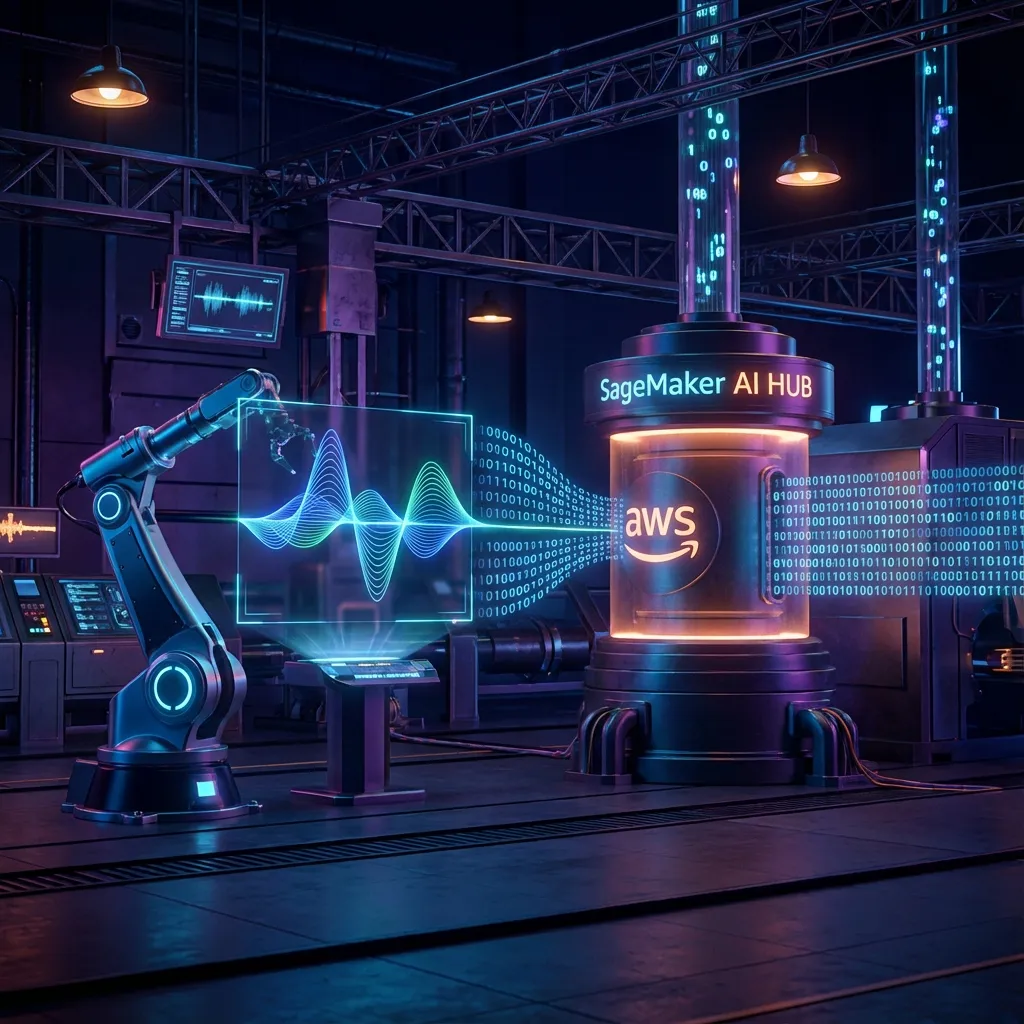
Deepgram, recognized for its expertise in Voice AI, announced a strategic move: the native integration of its services with Amazon SageMaker AI. This means that it is now possible to access in real time critical resources such as speech‑to‑text (STT), text‑to‑speech (TTS), and, most notably, its Voice Agent API, all as endpoints within the SageMaker ecosystem. For the Industrial Director, this translates into a radical simplification: less dedicated infrastructure, reduced operational costs, and the ability to build and scale sophisticated voice applications without leaving your AWS cloud.
The Alchemist’s Analysis
The market is buzzing with the concept of “AI agents”, but many confuse a sophisticated bot with a truly autonomous agent. Deepgram’s integration into SageMaker is not just about having a high‑performance STT or TTS; it’s about the Voice Agent API. A single agent, on its own, can be seen as a tool, a demonstration “toy”. The real power emerges when these agents can act autonomously, process complex intents, and, crucially, orchestrate themselves within a larger ecosystem. The “Alchemist” sees here the foundation for multi‑agent systems, where each component has its specialty – data collection, user interaction, backend system triggering – and all communicate fluidly. It is the architecture that enables the transition from mere assistants to intelligent process orchestrators, ready for the complexity of manufacturing and logistics, not just a call center.
Operational Impact
For the digital factory floor or the IT infrastructure of a large corporation, the Deepgram‑SageMaker integration promises to redefine three operational pillars:
- Robust Security: By keeping all voice data and processing within the AWS ecosystem, concerns about privacy and regulatory compliance are mitigated. Sectors such as healthcare and finance, operating under strict regulations, gain an extra layer of reassurance, eliminating the need to move sensitive data between different providers.
- Simplified Governance: Consolidating voice AI tools into a single AWS platform optimizes IT governance. Solution architects can plan, license, and support a unified stack, reducing administrative complexity and incompatibility risks.
- Intelligent Orchestration: The Voice Agent API enables the creation of systems capable of not only interpreting but also acting. Imagine agents controlling collaborative robots by voice, monitoring production lines and issuing predictive alerts, or facilitating human‑machine interaction naturally and efficiently, all orchestrated from a centralized cloud hub.
Conclusion
The year 2025 is being shaped by the convergence of agentic AI, the deep integration of artificial intelligence into already established workflows, and the inexorable rise of conversational interfaces. Deepgram on SageMaker is more than a technological update; it is a strategic invitation for industries seeking not just to optimize but to redefine their operations. It is the opportunity to build intelligent voice systems that not only react but anticipate, act, and integrate autonomously. The future of your operation is conversational, and it starts now, with intelligence and security.
To delve deeper into how agentic AI can transform your industrial strategy and to receive exclusive analyses like this, subscribe to our newsletter and discover the Centrato AI methodology.