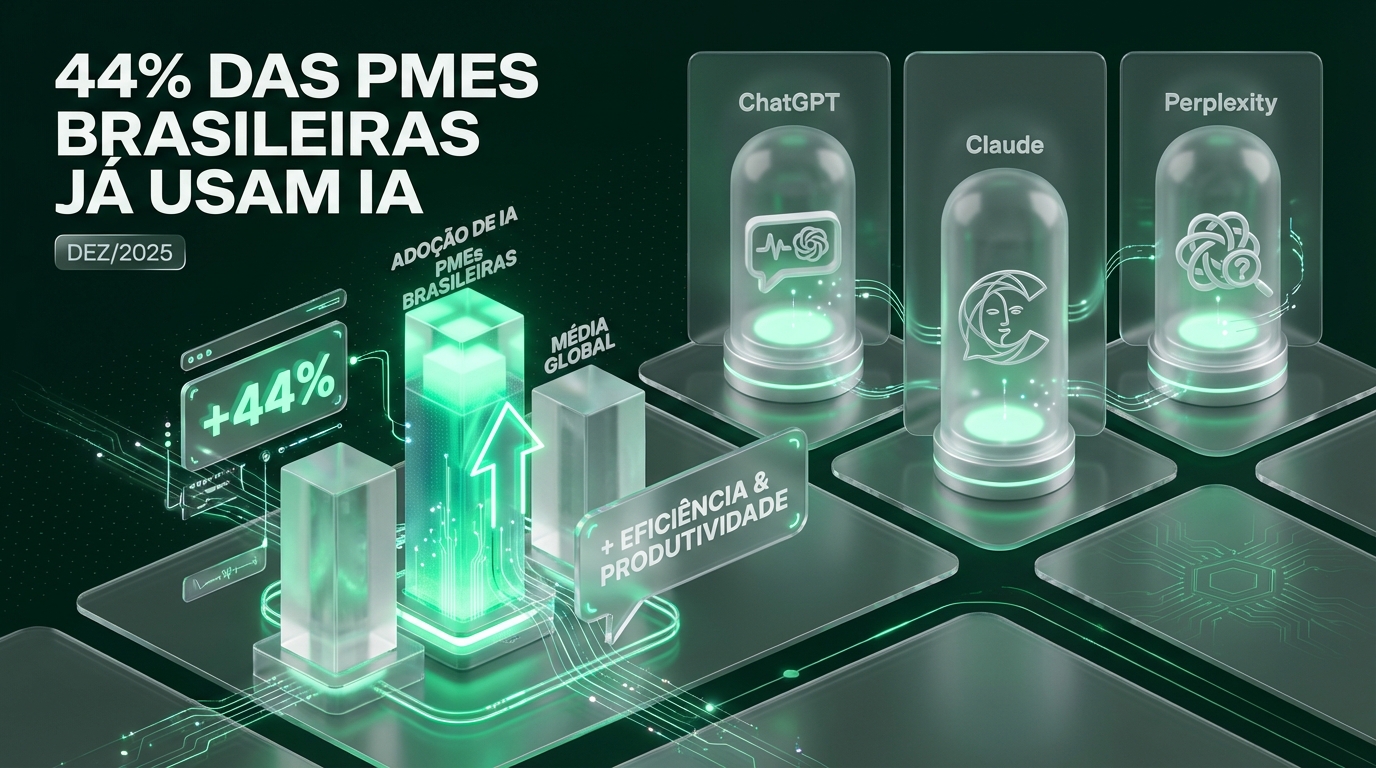
The era of artificial intelligence is no longer a futuristic promise or a privilege of large corporations. For the Industrial and Technology Director, reality imposes itself with an undeniable fact: 44% of Brazilian small businesses already use some form of AI in their operations, as revealed in December 2025. This number is not just a statistic; it is a seismograph of change, indicating that strategic inaction today could mean an irreparable competitive disadvantage tomorrow. It is a warning to everyone who still sees AI as an “extra” and not as a fundamental pillar of their planning.
What Happened
The ABC report, dated December 2025, paints a clear picture: almost half of Brazilian SMEs, companies with fewer than 50 employees and modest revenue, have already incorporated AI. This movement goes beyond expectations, demystifying the idea that advanced technology is limited to large budgets. The economic implications are vast:
- Accelerated Market Expansion: The latent demand for AI solutions for SMEs validates investment in verticalized SaaS, opening a range of opportunities for developers and consultants.
- Technology Democratization: Accessible tools such as ChatGPT, Claude, and Perplexity, with reduced entry costs, have enabled mass adoption without the need for complex infrastructure or data science teams.
- Tangible Competitive Advantage: Companies that acted gain agility and productivity in critical areas such as customer service, data analysis, and marketing, while hesitations translate into opportunity costs.
Notably, Brazil, with its 44%, is aligned or even slightly above the global average adoption among SMEs (35%-50%), challenging the perception of technological lag and reinforcing local innovation capacity. Sectors such as retail and e-commerce, professional services, HR, and customer service lead this transformation, exploring AI for recommendation, document analysis, recruitment, and 24/7 support.
The Alchemist’s Analysis
The 44% adoption figure is a milestone, but the real “gold” lies in the depth of that integration. For the Alchemist at Centrato AI, the question is not whether you use AI, but how you use it. A superficial adoption, limited to basic generative tools for occasional tasks, is only the first rung. The true transformation, the sustainable competitive edge, emerges from the orchestration strategy. It’s the difference between having a hammer and building a skyscraper.
Many SMEs are “using” AI, but few are dominating AI to redefine processes, optimize decision-making, or create new business models. The fragmentation of the provider market, with the emergence of DeepSeek and Grok, while positive for accessibility, also introduces complexity. Choosing a tool must be strategic, not merely reactive to hype. The challenge is to transcend the “toy” of a single tool and build an intelligent ecosystem where AI operates as an integrated and cohesive agent, not as a series of isolated points. It’s not enough to be among the 44%; you need to be among the 10% that will use it to dominate their markets.
Operational Impact: Security, Governance, and Strategic Orchestration
The proliferation of AI in SMEs immediately raises the urgency of three critical operational pillars:
- Information Security: The use of public LLMs and AI tools demands rigor in protecting proprietary and sensitive data. Lack of clear policies can expose the company to cyber risks and leaks, turning productivity into vulnerability.
- Governance and Compliance: With AI on the rise, the need for internal frameworks is urgent. How to ensure algorithmic fairness? Who is responsible for decisions generated by AI? The absence of clear governance leads to biases, wrong decisions, and future regulatory challenges, especially in a scenario where bodies like MCTI are already debating legal frameworks.
- Intelligent Orchestration: Adopting diverse tools without a unified strategy can create more silos than solutions. The true value of AI emerges when it is orchestrated to integrate processes, automate complex workflows, and provide actionable insights in real time. It’s not about replacing people, but empowering them with intelligent systems that eliminate repetitive operational work, freeing them for strategy and innovation.
Conclusion
The 44% AI adoption figure in Brazilian SMEs is a watershed. It’s not just proof that AI has arrived; it’s a warning that future competitiveness depends on your ability to integrate and orchestrate this technology strategically. For the Technology and Industrial Director, the question is not whether your company will use AI, but how well it will use it. Ignoring this trend is not an option; it’s a sentence of slow obsolescence.
Centrato AI is here to guide your company beyond simple adoption, to the intelligent orchestration of AI that generates exponential results. Want to understand how your operation can move from statistics to becoming a success story?
Discover the Centrato AI methodology for the strategic integration of artificial intelligence and transform your company into a true agent of innovation.