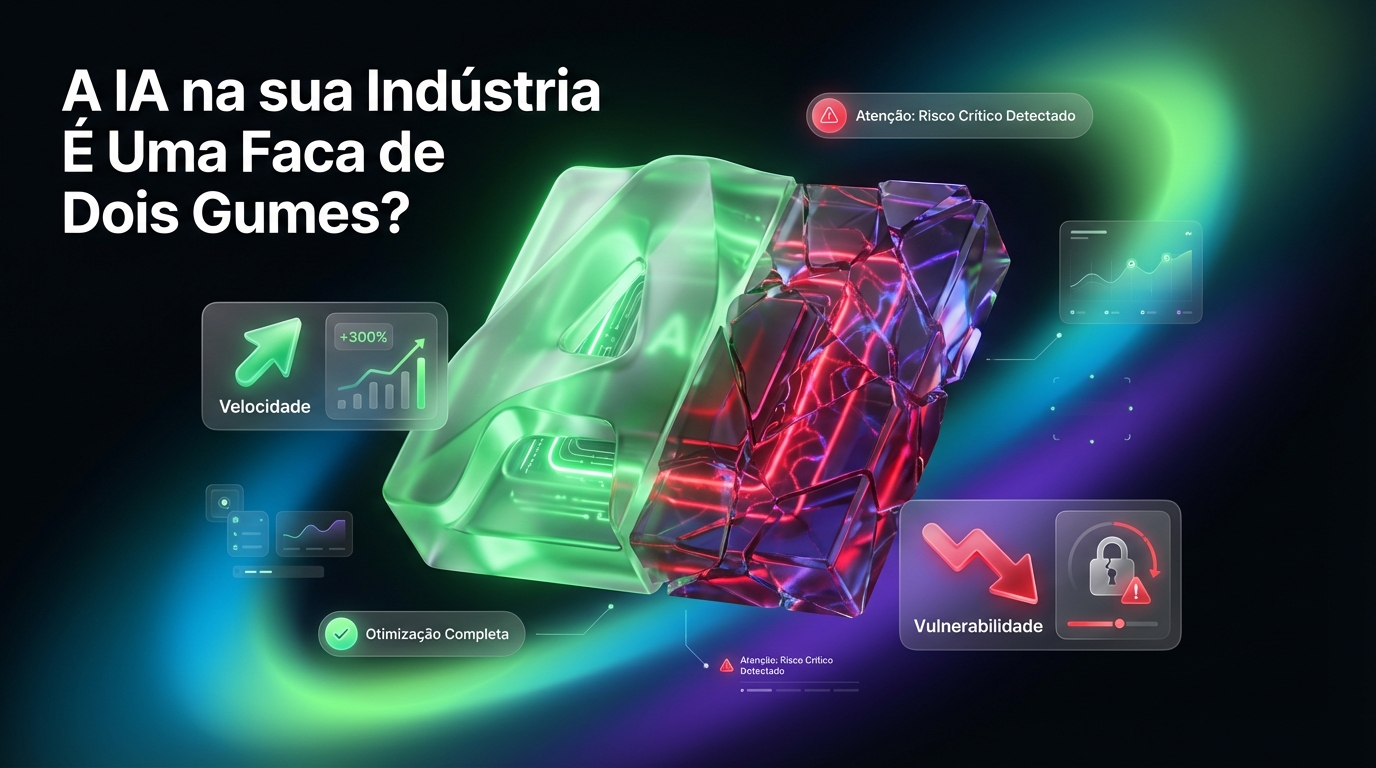
The race for efficiency in industry, driven by the massive adoption of Artificial Intelligence in development and programming, has created a dangerous paradox. While engineering and technology teams celebrate exponential gains in delivery speed, a critical blind spot emerges: the hidden security vulnerabilities that AI-generated code can introduce. The central question is not whether AI will bring speed, but whether your organization is prepared for the cost of a security bill after the agility party.
What Happened
The promise of AI in optimizing the development cycle is undeniable, but the reality is that every shortcut can hide a risk. The weaknesses are diverse and interconnected:
- Prompt Injection: One of the most insidious entry points. Malicious commands in prompts can ‘trick’ the AI into exposing sensitive data or generating code with nefarious intentions, turning a productivity tool into an attack vector.
- Hardcoded Secrets: In its eagerness for functionality, AI may ‘suggest’ including API keys, passwords, or credentials directly in the source code, which, once in production, become easy targets for attackers.
- Insecure Code Patterns: AI learns from a vast repository of data, which unfortunately includes examples of vulnerable code. SQL Injections, Path Traversal, and Command Injection can be ‘disguised’ as ‘quick fixes,’ perpetuating known security flaws in an automated way.
- Data Exfiltration: AI’s ability to manipulate and generate text can be exploited to create breaches that facilitate the theft of valuable information from your operation, whether through malicious logs, accidental leakage in outputs, or manipulation of data flows.
- Dependency Confusion: AI-generated code often includes suggestions for packages and imports. Without rigorous validation, this can introduce suspicious or compromised dependencies, opening doors for software supply chain attacks.
True efficiency in industry, especially in critical sectors, cannot be measured solely by delivery speed. It is defined by the resilience and unwavering security of what is built and deployed. Ignoring the inherent weaknesses of AI-generated code is not a saving, but rather the exchange of a marginal gain for a potential catastrophic loss.
The Alchemist’s Analysis: Why ‘Multi-Agent’ is the Future and a Single Agent is a Toy
The rise of these vulnerabilities exposes a fundamental flaw in many companies’ approach to security in AI-enabled environments: the belief that a single security ‘agent’—be it a SAST/DAST tool, a firewall, or even a security-focused AI assistant—can solve the problem. This is a simplistic, almost childish view in a complex scenario.
The reality is that security in the age of generative AI requires ‘multi-agent’ orchestration. We are not just talking about multiple software programs, but a layer of contextual intelligence that understands the interactions, intentions, and ramifications of every piece of code generated or modified. An isolated agent cannot predict the prompt injection that led to the insertion of a ‘hardcoded’ key, nor the interaction of an insecure package with a specific data flow that could lead to exfiltration.
The ‘Alchemist’ knows that security is a network of intelligence, not a single point of defense. It is necessary to integrate agents that analyze the prompt, the generated code, the dependencies, runtime behavior, and regulatory compliance. Only a symphony of intelligences, working together and continuously learning, can provide the resilience needed to protect critical assets in a world where code is generated at unprecedented scale and speed.
Impact on Operation: Security, Governance, and Orchestration
The consequences of these vulnerabilities go far beyond the code. They directly impact the heart of industrial operations:
- Security: The integrity of industrial control systems (ICS), SCADA, and other critical assets is compromised. A breach can lead to production interruptions, equipment damage, or, in the worst-case scenario, risks to the physical safety of workers.
- Governance: The lack of visibility and control over AI-generated code makes compliance with regulations such as LGPD, GDPR, NIST, or specific industry standards difficult. Audits become a nightmare, and regulatory fines can be severe.
- Orchestration: Poorly integrated or unmonitored AI systems can generate code that causes conflicts or inefficiencies in other operational modules, breaking the orchestration of complex systems and introducing bottlenecks that negate the speed gains promised by AI.
Ignoring these risks is allowing technology, without a proactive and integrated security strategy, to become a disguised cost that will eventually present itself as an incalculable loss.
Conclusion
AI is a transformative tool, but its implementation in industry requires a strategic vision that prioritizes security from conception. Productivity acceleration cannot be a pretext for neglecting robustness. Your AI strategy must be a pillar of protection for your assets, not the next point of failure that could paralyze your operation.
It is time to go beyond the euphoria of speed and build an AI architecture that is inherently secure, orchestrated, and resilient. A ‘multi-agent’ approach is what separates the promise of AI from its latent dangers, ensuring that innovation is, in fact, an advancement and not a leap into the dark.
Interested in deepening the security of your AI strategy? Subscribe to our newsletter for exclusive insights and methodologies that protect your industrial future.