Microsoft’s recent stumble with its ‘AI PCs’ offers a valuable lesson that resonates deeply within the industrial landscape. The promise of technological innovation, when detached from tangible value and a clear use case, quickly turns into a cost. This is not an issue exclusive to consumers; the industry faces the same challenge when adopting new technologies, from Artificial Intelligence to IoT.
What Happened
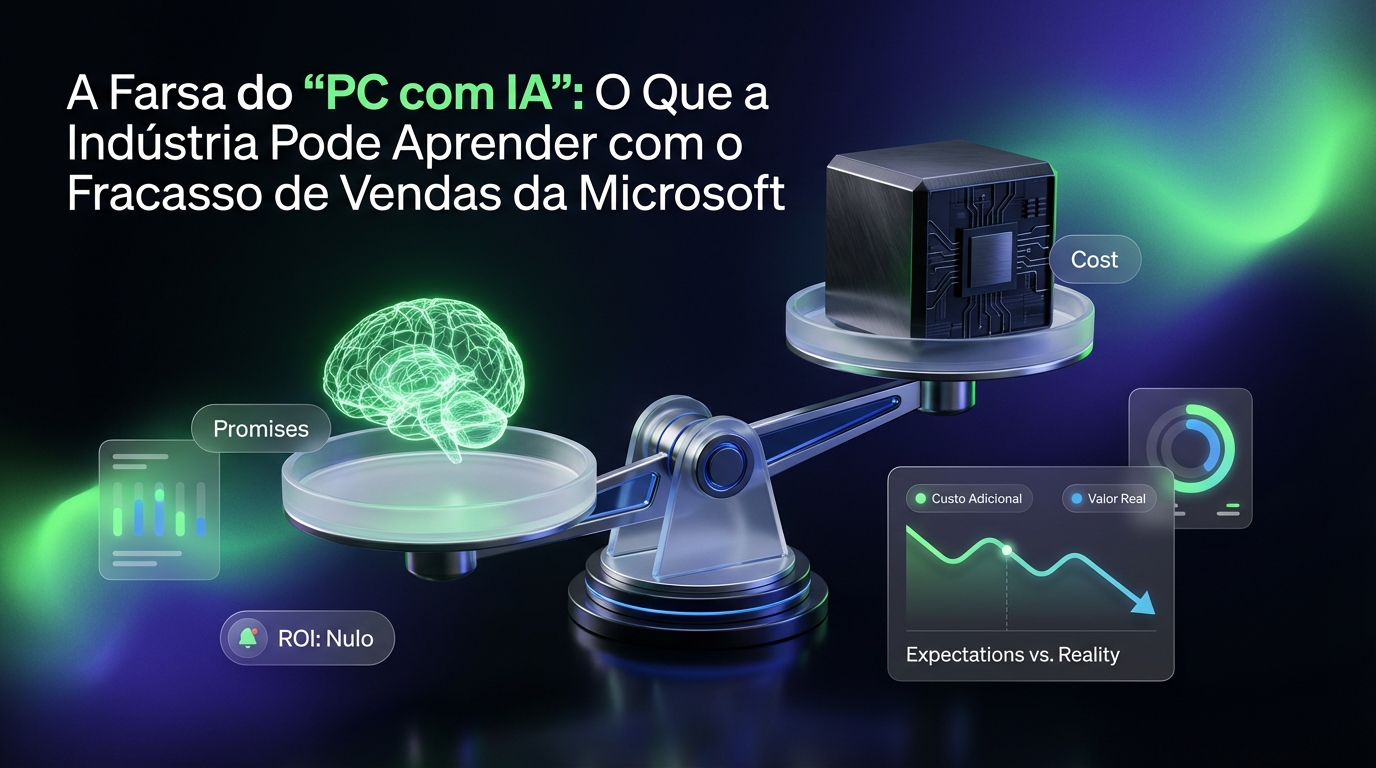
Microsoft’s ‘AI PC’ market is stagnant, and the data is clear. Partners like Dell report ‘unfulfilled promises,’ with consumers confused about the real benefits. AI features like Copilot, while technically advanced, did not offer daily advantages that justified the more expensive and specialized hardware. In an environment where alternatives already deliver functionality without the additional investment, innovation has become a cost, not a competitive advantage. The lack of a compelling use case makes ‘innovation’ seem like an additional cost rather than an investment with a clear return.
The Alchemist’s Analysis
The ‘Alchemist’ looks beyond the superficial shine of novelty. The failure of the ‘AI PC’ is not about the technology itself, but about the value strategy. In the industrial scenario, the analogy is even more powerful. How many times do we see companies investing in point solutions for AI, IoT, or Big Data, expecting ‘magic’ to happen? Without precise mapping of the most costly operational bottlenecks and a clear vision of ROI, these tools become ‘isolated agents,’ incapable of orchestrating systemic change.
True intelligence lies in the ability to integrate these ‘agents’ into a cohesive ecosystem, where each part contributes to solving a strategic and measurable problem, not just an ‘interesting’ feature. A ‘single agent’ without context is just an expensive toy; the symphony of multiple agents operating in harmony toward a common goal—that is transformative power. It is the difference between having a hammer and knowing how to build a house.
Impact on Operations
Microsoft’s lesson is a mirror for industrial management. Adopting technology without a strategic plan and without a focus on tangible value directly impacts:
- Operational Safety: Isolated or poorly integrated AI solutions can introduce complexities, create new points of failure, and, ironically, reduce visibility into critical processes instead of enhancing safety.
- Data Governance and Investments: When ROI is not clear, governance becomes an exercise in faith, not strategy. Investment decisions are compromised, and the proliferation of ‘magic solutions’ without concrete metrics makes efficient capital allocation difficult.
- Orchestration and Efficiency: The promise of ‘intelligence’ fades if AI cannot communicate and collaborate with existing systems. Instead of optimizing, it creates more data silos and fragmented operations, worsening the overall inefficiency of the plant or production chain.
Conclusion
The race for the industry’s next ‘AI PC’ is a trap. True transformation does not lie in the simple acquisition of ‘smart’ hardware or software, but in the ability to integrate this intelligence to solve the most expensive and complex problems of your operation. Ignoring this premise is to condemn investments to become just another additional cost instead of a growth engine. Don’t fall for the hype. Focus on strategy, tangible value, and systemic integration.
Want to understand how Centrato AI can help your industry transform AI promises into real results with clear and measurable ROI? Contact our specialists for a strategic assessment.