The question echoing through the corridors of modern industry is no longer whether Artificial Intelligence will impact the workforce, but how much its absence is already eroding your profits. In a scenario where efficiency is the most valuable currency, OpenAI, the vanguard of generative AI, has just triggered a warning signal that no industrial or technology director can ignore: the dramatic slowdown in hiring. It is not a trivial market maneuver; it is a strategic statement about AI’s ability to ‘do much more with fewer people.‘
What Happened
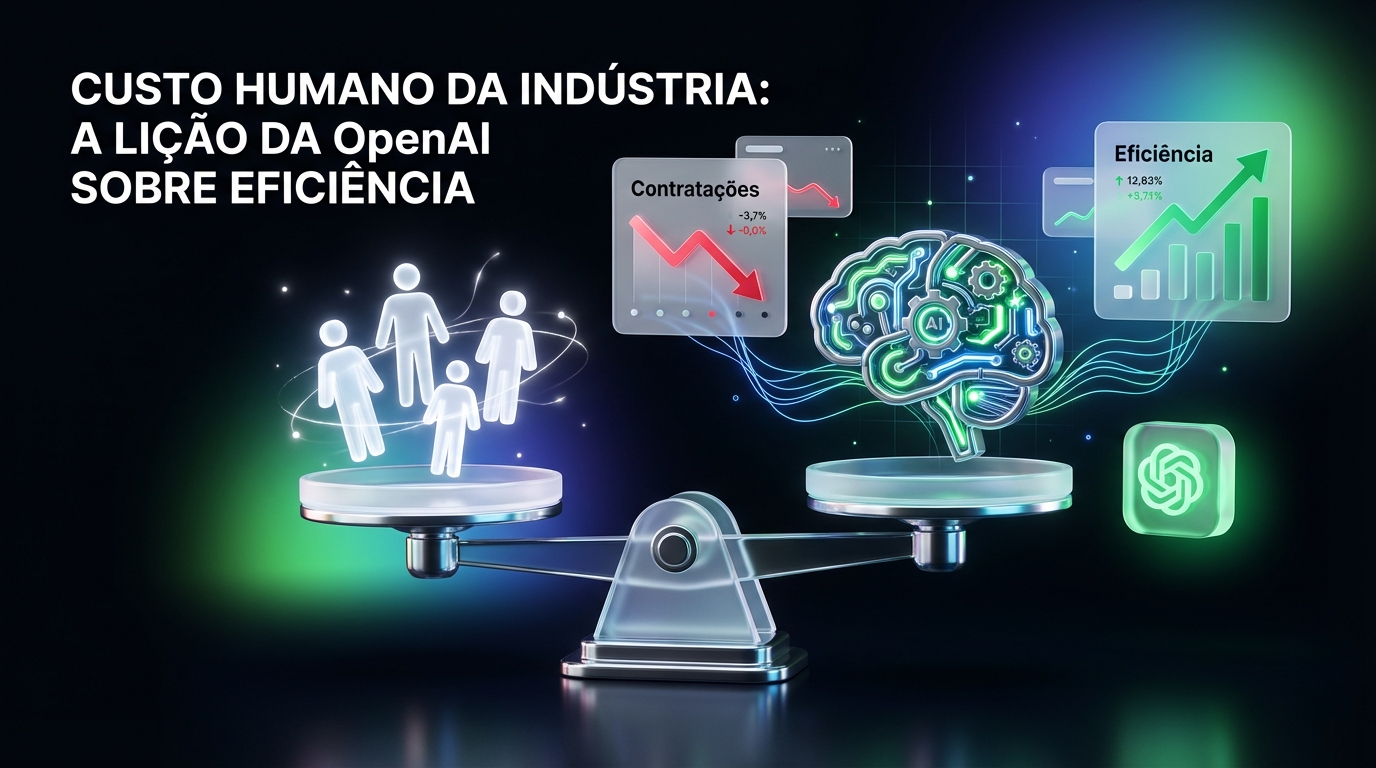
Recently, Sam Altman, CEO of OpenAI, made a clear announcement: the company will ‘dramatically slow’ its hiring pace. The justification is pragmatic and brutally direct: the ability of its own AI products to boost individual productivity to an unprecedented level. The goal is to avoid the vicious cycle of over-hiring only to subsequently have to carry out ‘uncomfortable’ and financially costly layoffs.
This move does not occur in a vacuum. It fits into the context of a global ‘Great Freeze,’ a significant slowdown in job creation affecting various economies. For industry, which traditionally operates with large workforces and processes that can be human-capital intensive, the lesson is crystal clear: if the organization that creates AI is redefining its staffing structure based on the efficiency provided by the technology itself, what is the justification for maintaining obsolete hiring and operating models in other sectors?
The Alchemist’s Analysis
Here at Centrato AI, we view AI not as a tool for pure and simple replacement, but as a catalyst for transmutation. OpenAI’s announcement is a milestone that separates basic automation—the ‘toy’—from true intelligence orchestration—the ‘multi-agent’ future. When we talk about ‘multi-agents,’ we are not just referring to isolated algorithms, but to a network of intelligences—human and artificial—collaborating synergistically. An isolated agent, human or machine, has its limits. The power lies in interconnection, in the ability of an AI system to not only automate repetitive tasks but to learn, adapt, and optimize complex processes in real-time, freeing up human capital for tasks of higher strategic and creative value.
The real ‘loss’ is not in reducing staff, but in maintaining ‘bloated’ teams and manual processes where AI could generate a quantum leap in productivity and insight. Inaction becomes the greatest cost, a silent bleed on the payroll and competitiveness. ‘Safety’ does not lie in maintaining an outdated status quo, but in the agility to integrate AI to optimize every function, every cell of your operation.
Impact on Operations
OpenAI’s reassessment projects three critical impact vectors for industrial operations:
- Efficiency and Costs: The most obvious is payroll optimization. By automating repetitive tasks and optimizing workflows, AI allows existing teams to be more productive, or fewer people to perform the same volume of work, or even more. This translates directly into reduced operating costs and increased margins.
- People and Process Governance: AI integration requires new governance. How are new roles defined? Which skills are priorities? How to measure performance in a hybrid human-AI environment? HR policies and operations management need to be rewritten to accommodate this new reality, focusing on reskilling and strategic talent allocation.
- Intelligent Orchestration: The lesson is not just about ‘fewer people,’ but about the better orchestration of resources. AI can act as a conductor, coordinating everything from the supply chain to production, including predictive maintenance, ensuring that every component—human or digital—operates at its maximum capacity. This raises factory resilience and adaptability to new levels.
Conclusion
OpenAI’s warning is an invitation for introspection and action for the industrial sector. Ignoring the transformative potential of AI in human resource management and process optimization is not a ‘safety’ strategy, but a passport to irrelevance. Your factory can be a well-tuned orchestra, where AI amplifies human mastery, or an out-of-tune choir that loses the melody of efficiency.
It’s time to reevaluate every function, every process. The question is not whether you can afford to have AI, but whether you can afford not to have it. Contact Centrato AI and discover how our methodology can help your industry navigate this transformation, optimizing your ‘human cost’ and maximizing your profitability through an intelligent and strategic approach to AI. Don’t waste time; the vanguard is already in motion.