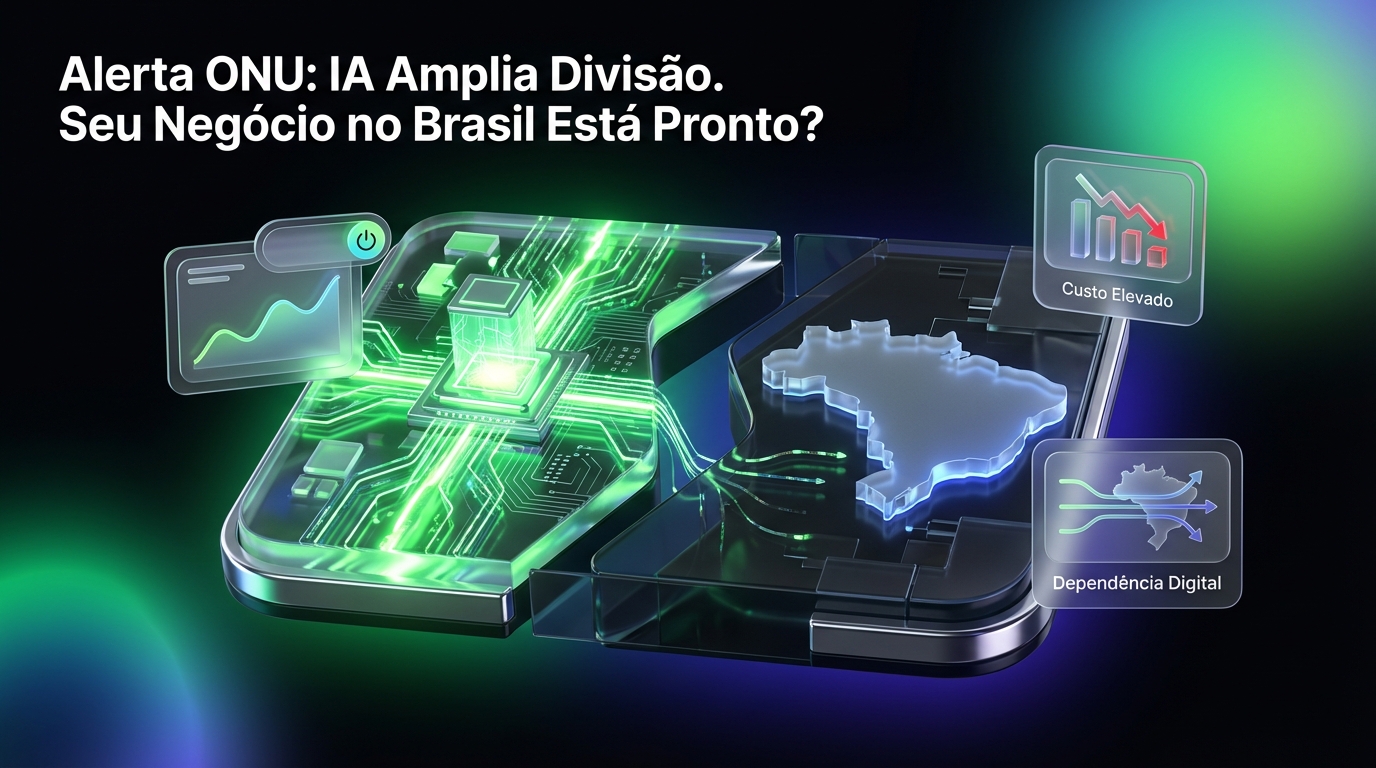

The adoption of Generative Artificial Intelligence in Brazil has reached an impressive milestone: 50 million people already use tools like ChatGPT and similar. This number, revealed by the CGI.br’s TIC Domicílios 2025 survey, positions the country as one of the largest AI markets in the world in absolute terms. However, for any Industrial or Technology Director seeking to build a long-term strategy, reading this headline must go beyond initial enthusiasm. Behind the volume lies a profound inequality that, if not addressed, can transform a potential mass market into an elitist niche, severely limiting the true impact and scalability of your operation.
What Happened
The data from the TIC Domicílios 2025 survey is clear: 32% of Brazilian internet users, equivalent to approximately 50 million individuals, already interact with generative AI. This accelerated growth since 2023 is undeniable. But the intelligence lies in interpreting the details:
- Profound Inequality: Adoption is 69% in class A, but plummets to 16% in classes D/E. In educational terms, 59% of users have higher education, compared to only 17% with elementary education. Geographically, the Southeast leads with 38%, while the North records 22%.
- Usage Profile: The 16-24 age group leads (45%), and 62% of users use it weekly. Predominant applications are text generation (48%), images (31%), and code (12%).
- Access: 71% use free mobile applications, while 18% pay for premium subscriptions.
- Barriers: Classes D/E cite mobile data cost (42%) and lack of knowledge (35%) as the main obstacles.
These numbers paint a picture of massive adoption, yes, but with a concentration of value and engagement in specific segments. Ignoring this segmentation is betting on strategic myopia.
The Alchemist’s Analysis
As Artur at Centrato AI, my view is that the “50 million users” is a mirage if you don’t understand the “other 80%” who are being neglected. An AI product that serves only the elite is not a scalable solution for Brazil; it is a luxury, a “toy” for a few. The true alchemy lies in transforming this untapped potential into real and democratized value.
Looking only at the wealthiest 20%, who are currently the biggest adopters and payers, is to miss the exponential opportunity hidden in the remaining 80%. This abyss is not just social; it is a market abyss. Classes C, D, and E represent a gigantic volume of potential users, but they require completely different product and pricing approaches. The barriers are not technological intrinsic to AI, but rather related to access and knowledge – problems that can be overcome with strategy.
Building a truly robust and strategic AI ecosystem in Brazil means developing “multi-agents,” that is, solutions adapted to different realities. This goes beyond mere social inclusion; it’s about building market resilience and ensuring that your innovation doesn’t become obsolete by focusing on a niche that, while profitable in the short term, drastically limits its long-term growth and impact potential.
Impact on Operations
For the Industrial or Technology Director, this survey is not just a statistic; it’s a map to redefine priorities:
- Inclusive Product Strategy: Develop “low-data” or “offline-first” versions for regions with limited connectivity. Focus on intuitive and accessible interfaces that minimize the need for prior technical knowledge. Usability should be universal, not elitist.
- Adaptive Pricing Models: Create segmented offers that consider the purchasing power of different classes. The “freemium” model with robust basic functionalities via mobile apps can be key to penetrating classes C, D, and E.
- Talent Development and Localization: Invest in training talent in diverse regions and social classes. Solutions that understand Brazil’s cultural and socioeconomic nuances are built by teams that reflect this diversity. This also means training AI models with data that represents the plurality of Brazilian Portuguese, and not just specific dialects.
- Strategic Partnerships and Political Engagement: Collaborate with the public sector (like CGI.br itself) and educational institutions to develop digital literacy programs and broadband subsidy policies. The AI Legal Framework (PL 2338/2023) should be seen as an opportunity to shape a more equitable and sustainable future for AI in the country.
- Competitive Advantage: Companies like Nubank and Magazine Luiza did not grow exponentially by focusing only on class A. They built businesses for “real Brazil.” Ignoring the next 30, 50 million AI users in less favored classes is to cede ground to competitors with a more inclusive and, consequently, more scalable vision.
Conclusion
The 50 million generative AI users in Brazil are a milestone, but the inequality in adoption is a call to action. The true strategy is not just to celebrate current numbers, but to plan for the “next 80%” of the market that are waiting for intelligent, accessible, and truly impactful solutions. Centrato AI believes that the future of AI in Brazil depends on our ability to innovate with inclusion, transforming barriers into bridges for sustainable and widespread growth. Don’t let your AI be a luxury; transform it into an essential tool for everyone. Is your company ready to embrace this vision?
Want to deepen your AI strategy for your industry? Subscribe to our newsletter and receive exclusive analyses on the trends that truly matter.