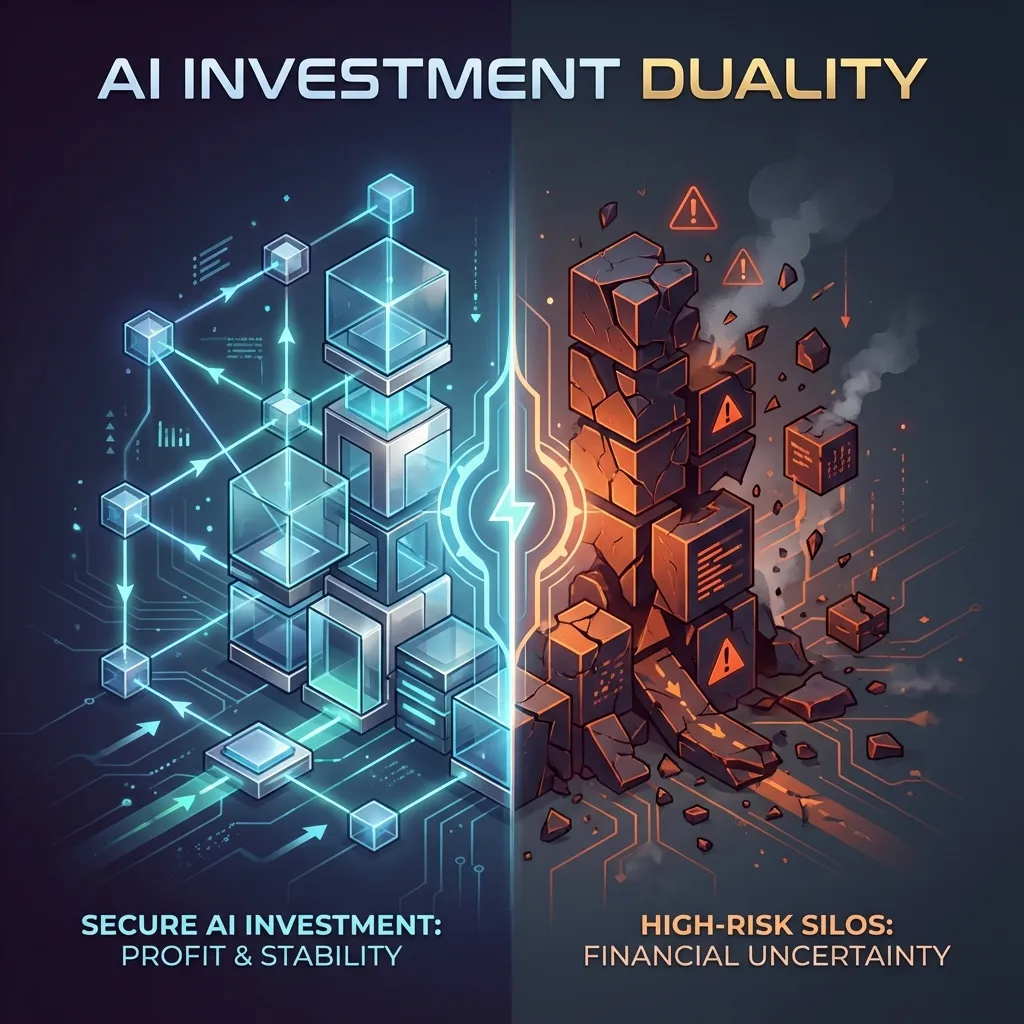

The recent warning from the United Nations (UN) about Artificial Intelligence’s potential to deepen inequalities between rich and poor nations resonates as an alarm bell, not only in the geopolitical landscape but directly within the boardrooms of Brazilian companies. For the industrial director and technology leader, this is not a distant concern; it is a strategic issue that could dictate operational sovereignty, competitiveness, and ultimately, the security of their business in the near future.
What Happened
The UN report, released amidst a global debate on AI governance, points to an alarming concentration of computational power and data. While technological powers invest trillions in infrastructure and cutting-edge models, developing nations like Brazil find themselves in a position of increasing dependence. This manifests in four critical ways:
- Concentration of Computational Power: The ability to train and operate large-scale AI models is restricted to a few corporations and governments. Brazilian companies, in turn, resort to foreign APIs and cloud services, paying a premium for innovation they do not possess.
- Data Dependence: AI feeds on massive, high-quality data. Rich countries have a history of structured collection, while Brazil often sees its data mined by multinationals who use it to train systems, only to resell it later.
- Digital Exclusion and Unequal Access: Although the adoption of AI by young Brazilians for generating ideas (66%), creating images (63%), and other activities is notable, this adoption is largely for consumption. The barrier to accessing advanced infrastructure and technological literacy perpetuates a cycle of advantage for developed nations.
- Disproportionate Technological Unemployment: AI-driven automation can displace jobs in countries with less resilient markets, like Brazil, more abruptly, without the corresponding capacity to absorb workers into new, high-value-added roles.
The Alchemist’s Analysis
To consider AI merely as a tool to be “consumed” via APIs or cloud services is like using a microscope to chop wood: an inadequate application for transformative potential. The UN’s warning underscores a fundamental truth in the age of AI: sovereignty and real value reside in the ability to create and control the essential “elements” – data, models, infrastructure, and talent – and not just in “buying” the final result. An AI “agent” without a sovereign foundation is a toy, not a lasting strategic advantage.
For the Alchemist, the alchemy of AI is not in having access to a pre-trained model, but in mastering the transmutation of raw data into proprietary intelligence, in building the infrastructure that ensures resilience and control, and in cultivating talent that innovates from within. Passivity here is not neutral; it is a strategic choice that consolidates dependence and limits the potential for differentiation.
Operational Impact
For the Industrial Director, the operational implications of this scenario are tangible and critical:
- Data Security and Sovereignty: Dependence on foreign cloud computing exposes your company to risks of interruption, cost fluctuations, and, more seriously, the loss of control over your most sensitive data. Investments in national data centers (REdata) and on-premise or hybrid solutions cease to be a luxury and become a strategic security imperative.
- Governance and Compliance: How can you ensure “responsible AI” in your operation if the underlying infrastructure and models are outside your direct control? Effective AI governance requires transparency, auditability, and ethical alignment that can only be fully achieved with a significant degree of control over the technology stack.
- Strategic Orchestration of Innovation: The “exponential advantage” of rich countries translates into a competitiveness chasm. Your AI strategy cannot be reactive. It demands the orchestration of investments in team training, attracting AI talent, and developing localized solutions that address specific Brazilian problems, rather than merely replicating global tools.
Conclusion
The UN’s warning is not a mere footnote; it is a map that exposes risks and, simultaneously, points to a critical window of opportunity. Brazil has taken important steps, such as the USP-Google Chair for Responsible AI and discussions about the REdata Regime. However, this window narrows every quarter. Ignoring this dynamic is to condemn your operation to an eternal consumer position, paying for the privilege of using tools created elsewhere, without the ability to shape your own digital destiny. The time to build digital sovereignty and AI innovation capacity, through a robust and pragmatic strategy, is now.