
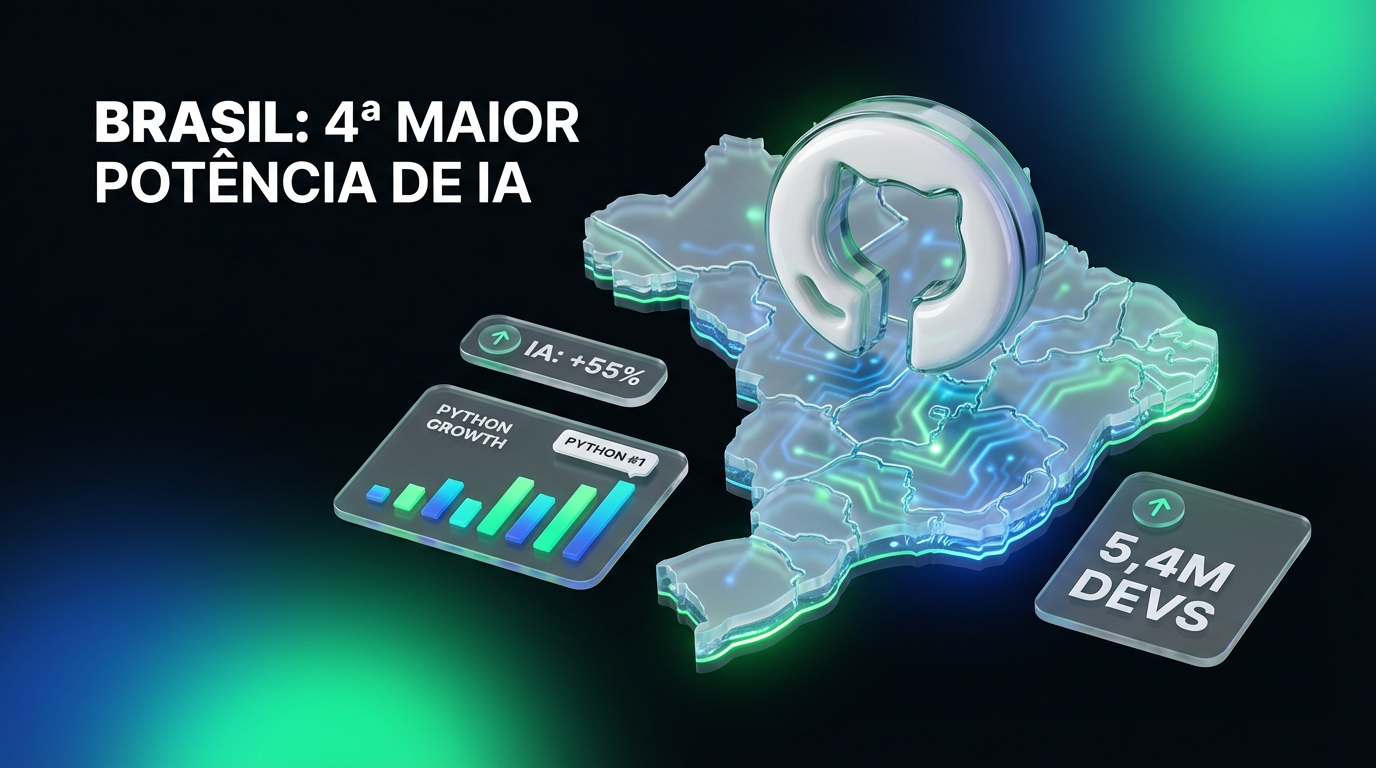
GitHub’s recent Octoverse 2024 report revealed a scenario that redefines Brazil’s position on the global artificial intelligence chessboard. We are talking about a 55% growth in contributions to generative AI projects and a base of 5.4 million developers, which places us as the 4th largest power in terms of talent numbers. It is a figure that, at first glance, makes anyone proud. But for an Industrial or Technology Director, the question transcends national pride: how can this tsunami of talent and innovation actually be translated into competitive advantage and tangible ROI for your operation?
What Happened
The numbers speak for themselves and are undeniable. In 2024, Brazilian contributions to generative AI on GitHub not only grew by 55%, but also saw a 41% increase in the number of contributors. Brazil added approximately 924,000 new developers in one year, surpassing the average growth of countries like Mexico and Argentina in Latin America. Globally, GitHub recorded a 59% “surge” in generative AI contributions, with GitHub Copilot writing 30% of Python functions—a language that, in Brazil, has already surpassed JavaScript as the primary one, highlighting our focus on Data Science and Machine Learning. The 92% increase in the use of Jupyter Notebooks corroborates this shift. Local projects, such as GAIA (Gemma optimized for Portuguese by the University of Goiás), already demonstrate the direct impact of this capability, being adopted by Brazilian government institutions. Add to this a government plan of US$ 4 billion in AI investments, and we have a buzzing environment.
The Alchemist’s Analysis: Why ‘Multi-Agents’ is the Future and a Single Agent is Just a Toy
The rise of Copilot and other AI tools that accelerate coding is undeniable. However, seeing AI merely as an isolated “agent” to optimize code writing is, to say the least, simplistic. A single Copilot, however much it increases individual developer productivity, is an “agent” operating within a limited scope if it is not part of a larger orchestration. The true power lies in the logic of “multi-agents”: not as a pure software architecture, but as a metaphor for exponential collaboration. Think of the synergy of 5.4 million Brazilian developers, from open source to internal projects, all contributing and learning in an ecosystem. This is the power of distributed collective intelligence, where each contribution (each “agent” or set of “agents”) integrates into a larger system, learning and evolving continuously. The beauty of open source, exemplified by projects on GitHub, lies exactly in this: the ability to scale innovation through massive collaboration. Ignoring this dynamic and focusing only on the individual tool is like buying the most powerful engine in the world and putting it in a car without a steering wheel or suspension.
Impact on Operations: Security, Governance, Orchestration
With this explosion of talent and tools, a Director’s challenge is no longer “whether” to use AI, but “how” to use it strategically and safely. Copilot can write 30% of the code, but if the data feeding it is in silos, if model governance is non-existent, or if internal processes still depend on spreadsheets and emails for critical approvals, you will only have “high-speed chaos.”
- Security and Compliance: With more code being generated and more talent contributing, the attack surface and compliance complexity increase exponentially. How to ensure that contributions, even internal ones, follow security standards and regulations (LGPD, ISOs) without slowing down innovation?
- Data and Model Governance: The proliferation of models and the intensive use of data (especially with the growth of Jupyter Notebooks) requires robust governance. Who owns the data? How are models versioned? What is the model lifecycle? Without this, “intelligence” becomes a liability.
- Orchestration and Integration: The ability to generate code quickly is fantastic, but how do you integrate this code and these models into legacy systems? How do you orchestrate a workflow that combines the best of AI with existing business processes, ensuring that AI is not an island of excellence, but a river that irrigates the entire operation?
Having 5.4 million talents is an invaluable asset. But if your data governance and processes remain analog or disjointed, what was meant to be an advantage could become a source of risk and waste.
Conclusion
Brazil is not just “using” AI; we are actively building its future, with a developer base growing at a fast pace and a clear shift toward the languages and tools of the new era. For your company, the fundamental question is not whether Brazil will be an AI power—the data shows we already are. The question is: are you prepared to transform this workforce and this innovation capacity into real strategic value, or are you just paying for licenses and watching the chaos accelerate?
Centrato AI is here to help your organization map this transformation, ensuring that your AI investment converts into concrete results, with governance, security, and a strategy that connects Brazilian talent to your operation. Stop just accelerating in the dark and build a clear map for AI success. Let’s discuss how our methodology can optimize your journey.