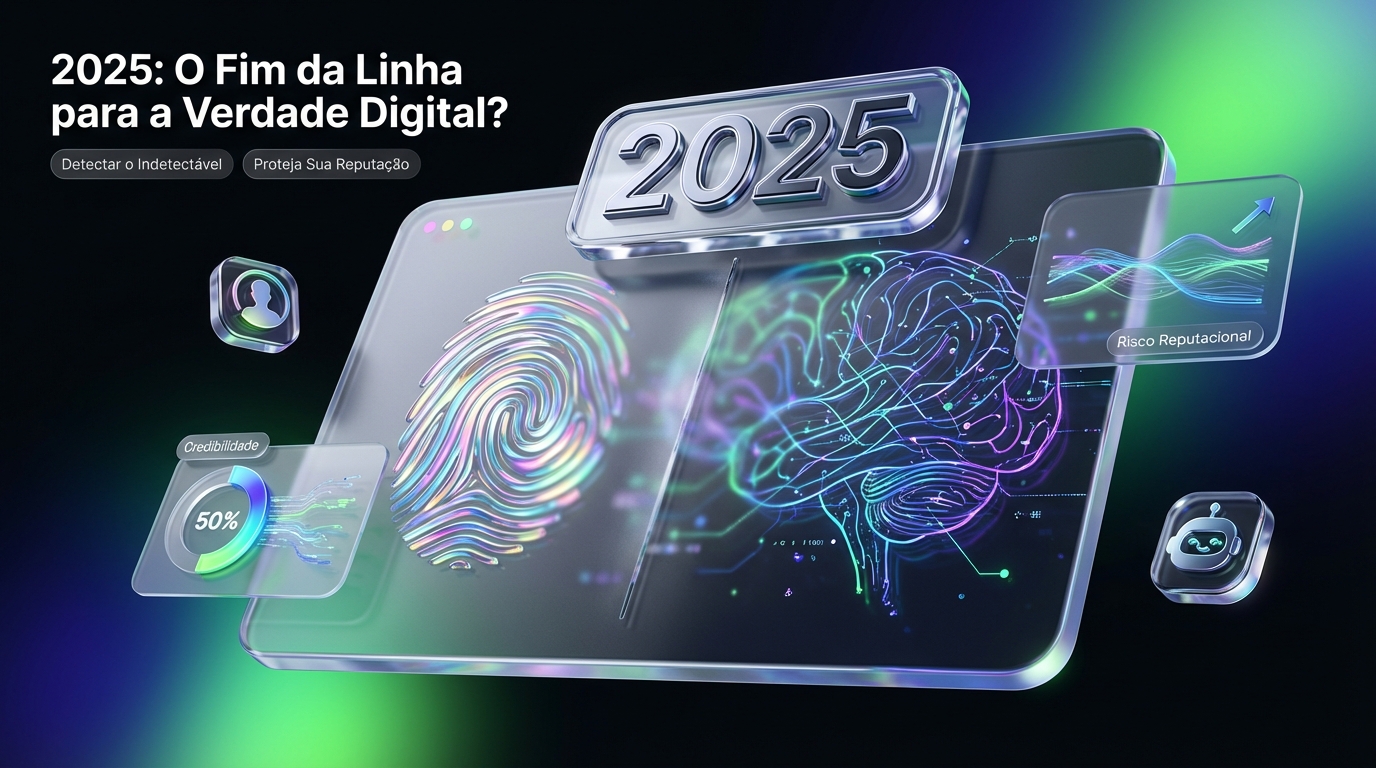
The TVT News headline – “2025 could be the last year we can still safely differentiate what is human from what is artificial” – is not just a sensationalist warning. For directors and leaders of industrial and tech companies, this statement is a beacon for the imminent turbulence that will redefine trust, security, and governance in digital environments.
Historically, trust in information depended on the visible source. Now, this fundamental premise is in question. The ability to distinguish the real from the synthetic is the cornerstone of decision-making, cybersecurity, and reputational integrity. Ignoring this transformation is accepting a vulnerability that can cost more than imagined.
What Happened
In the last two years, generative AI has demonstrated an astonishing ability to create content indistinguishable from human-made. Studies with large language models (LLMs) show that the accuracy rate of humans differentiating real from synthetic texts borders on chance, especially in academic and corporate contexts. With voice and video deepfakes, the situation is even more critical: without specialized forensic tools, ordinary users cannot identify manipulations, making it a fertile ground for fraud and voice cloning scams.
This scenario is not hypothetical; it is the reality of digital platforms today. In a constant flow of information, most people no longer have the practical conditions to discern what is human from what is AI, unless there are robust external traceability or auditing mechanisms. The speed of generative AI adoption and the scale of synthetic content flooding social networks exponentially amplify this challenge.
The Alchemist’s Analysis: Why Indistinguishability Demands Multi-Layered Defenses
The “Alchemist” here observes that the indistinguishability between human and AI is not a mere technological curiosity; it is a seismic fault in the foundation of digital truth. For the industrial or technology director, this is not a “marketing” problem, but an existential threat to operational integrity and brand trust.
Relying on isolated solutions or the individual ability of your employees to “sniff out” a deepfake is naive. A solitary agent, without a support ecosystem, is a plaything in this asymmetric battlefield. The proliferation of generative AI creates an asymmetry of power: while large actors (states, large corporations, organized groups) can produce and disseminate synthetic content en masse, the average person – or even an organization without the right strategy – is easily overwhelmed and deceived. Trust erodes, and with it, the basis of any relationship, whether with clients, partners, or even internally.
That’s why the approach must be multi-layered, like a complex defense system. It’s not about a single detection tool, but an orchestration of policies, monitoring technology, continuous training, and strategic partnerships. Authenticity, once an assumption, becomes a characteristic that needs to be actively protected and verified at every digital touchpoint.
Impact on Operations
Indistinguishability has profound and tangible implications for the operation of any company:
- Reputational Risk: Fake videos or audios of executives, fabricated information about products or processes can trigger devastating image crises. It is imperative to have clear protocols for responding to deepfake attacks and accessible technical expertise.
- Governance and Compliance: Internal policies for generative AI use need to be reviewed. What data can be used in prompts? How to ensure compliance with new AI legislations, such as PL 2.338/2023, which will require diligence and traceability in generated content?
- Information Security: Phishing and social engineering scams become exponentially more sophisticated with voice cloning and massive personalization via AI. Protection against data leaks and the integrity of operating systems are directly affected.
- Human Resources and Training: The validation of AI-produced resumes, tests, and portfolios complicates talent assessment. Furthermore, training employees to recognize AI-generated threats, from fake emails to deceptive phone calls, becomes a pillar of internal security.
- Communication and Marketing: The pressure for transparency will be immense. Labeling AI-generated content will not just be good practice, but a requirement to maintain credibility. Fact-checking routines will need to evolve to distrust “visual” and “auditory” sources that were once considered irrefutable proof.
Conclusion
2025 is not just a year on the calendar; it is a strategic inflection point. The ability to distinguish the human from the artificial, which was once a matter of perception, has now become a systemic challenge with profound ramifications for corporate security, governance, and reputation.
For industrial and technology leaders, the time to act is now. It is necessary to create or update internal AI policies, invest heavily in media and digital literacy for teams, implement rigorous transparency practices in communication, and seek partnerships with digital security and forensics experts. Don’t wait for the crisis to knock on your door. Centrato AI is here to help your organization build this resilience, transforming technological challenges into strategic advantages. Connect with us and prepare your strategy for the era of fluid digital truth.