The Unified Health System (SUS), the backbone of Brazilian healthcare, faces monumental challenges: waiting lists stretching across millions of patients, operational bottlenecks, and a growing demand for quality services. In this scenario, the announcement of a strategic partnership between Brazil and China, with an investment of R$ 4.5 billion, marks a decisive turning point. The goal? To transform the Hospital das Clínicas of USP (HC-USP) into the first smart hospital of the SUS, a quantum leap in the application of artificial intelligence to optimize everything from triage to complex telesurgeries, promising a revolution in efficiency and access to public health.
What Happened
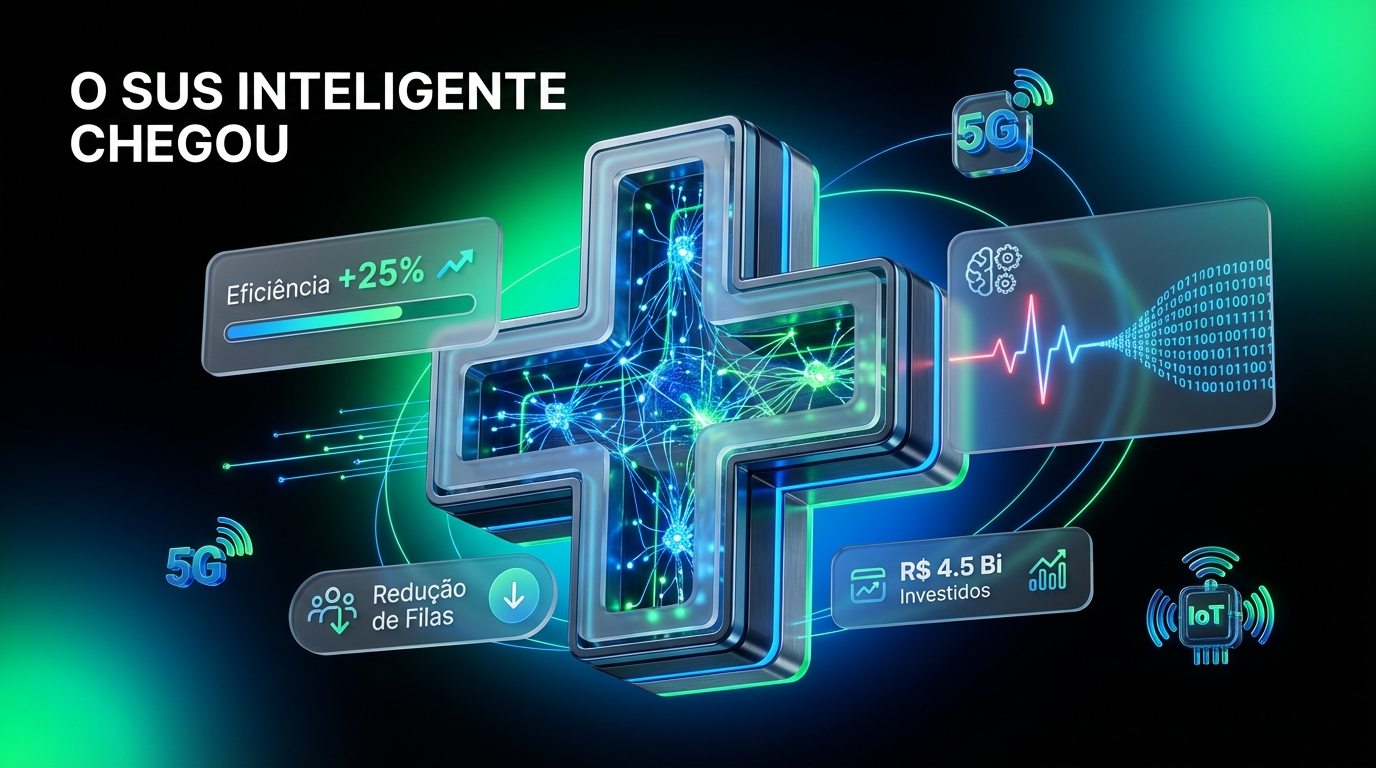
The Sino-Brazilian partnership directs R$ 4.5 billion toward AI infrastructure at HC-USP. This monumental investment is not just financial; it represents the deployment of a complete technological ecosystem. IoT sensors will monitor patients in real-time, predictive algorithms will identify clinical risks, and data integration platforms will unify electronic health records. At the center of this transformation are features such as:
- Smart Triage: Using multimodal AI (image and voice analysis), a 25% reduction in emergency wait times is expected.
- Predictive ICUs: AI monitoring to anticipate vital failures, with the potential to decrease mortality from human error by 15%, based on proven Chinese models.
- Telemedicine and Telesurgeries: The integration of 5G will enable AI-assisted remote consultations and minimally invasive robotic surgeries, promising to reduce costs by 10% and surgical time by 20%, while expanding access to 70% of Brazil’s remote regions.
Pilot tests already reveal 30% greater efficiency in diagnostic imaging, a clear indicator of the scaling potential for the SUS, which currently spends R$ 200 billion annually on healthcare and faces a backlog of 5 million surgeries.
The Alchemist’s Analysis
The mere application of Artificial Intelligence tools, in isolation, can be as ineffective as a diagnosis without treatment. What differentiates this project at HC-USP is not just the sophistication of the AI, but the strategic vision of orchestrating multiple technological “agents” into a cohesive ecosystem. The Alchemist knows that data scattered in operational silos is inert; true transformation occurs when this data is harmonized and contextualized, feeding a systemic intelligence.
An AI agent focused only on triage, another on the ICU, and a third on telemedicine, without fluid communication, would replicate human bottlenecks at a digital level. The “intelligence” here lies in the ability to interconnect electronic health records, IoT sensor data, treatment histories, and bed logistics information. It is this radical breaking of data silos that allows AI not only to diagnose or optimize a single stage but to predict, react, and optimize the complete patient flow, from first contact to post-operative care. This transforms AI from an “innovation cost” into an efficiency machine and, more critically, into a multiplier of lives saved.
Impact on Operations
For industrial and technology directors, the magnitude of this project transcends the healthcare sector and serves as a blueprint for digital transformation in any complex operation. The operational ramifications are profound:
- Information Security: With the integration of so much sensitive data, cybersecurity and patient privacy protection (in line with LGPD) become paramount. This project requires robust security architectures from the design phase, shielding systems and ensuring the integrity of clinical data.
- Data and AI Governance: Implementing AI at scale in the SUS demands rigorous governance over data collection, use, and interpretation. This includes auditing algorithms to avoid bias, compliance with ethical regulations, and clarity regarding responsibilities in critical decision scenarios. The partnership with China even includes data sovereignty clauses, a crucial aspect for replicability in other industries.
- Orchestration of Flows and Resources: AI acts as the conductor, orchestrating patient flow, ICU bed allocation, teleconsultation scheduling, and surgical team management. The promise of a 25% reduction in emergency wait times and 10% in operational costs is not a miracle, but the direct result of intelligent process orchestration, where inefficiency is systematically eliminated.
Conclusion
The investment in HC-USP is more than the modernization of a hospital; it is the materialization of a national strategy to face an imminent collapse of the healthcare system. It demonstrates that Artificial Intelligence, when applied with a holistic and integrated vision, has the power to solve massive-scale problems, transcend geographical barriers, and, ultimately, save lives and billions in resources.
For industrial and technology leaders, the lesson is clear: disruption will not come from a single “miracle” technology, but from the ability to integrate multiple fronts of innovation, break silos, and orchestrate processes to generate systemic efficiency.
Is your operation prepared for this revolution? Do not wait for the collapse to arrive before seeking transformation.
Want to understand how Centrato AI’s methodology can transform your processes, integrating AI and breaking the silos that hinder growth? Subscribe to our newsletter and receive strategic insights or contact us for a digital maturity analysis of your company.