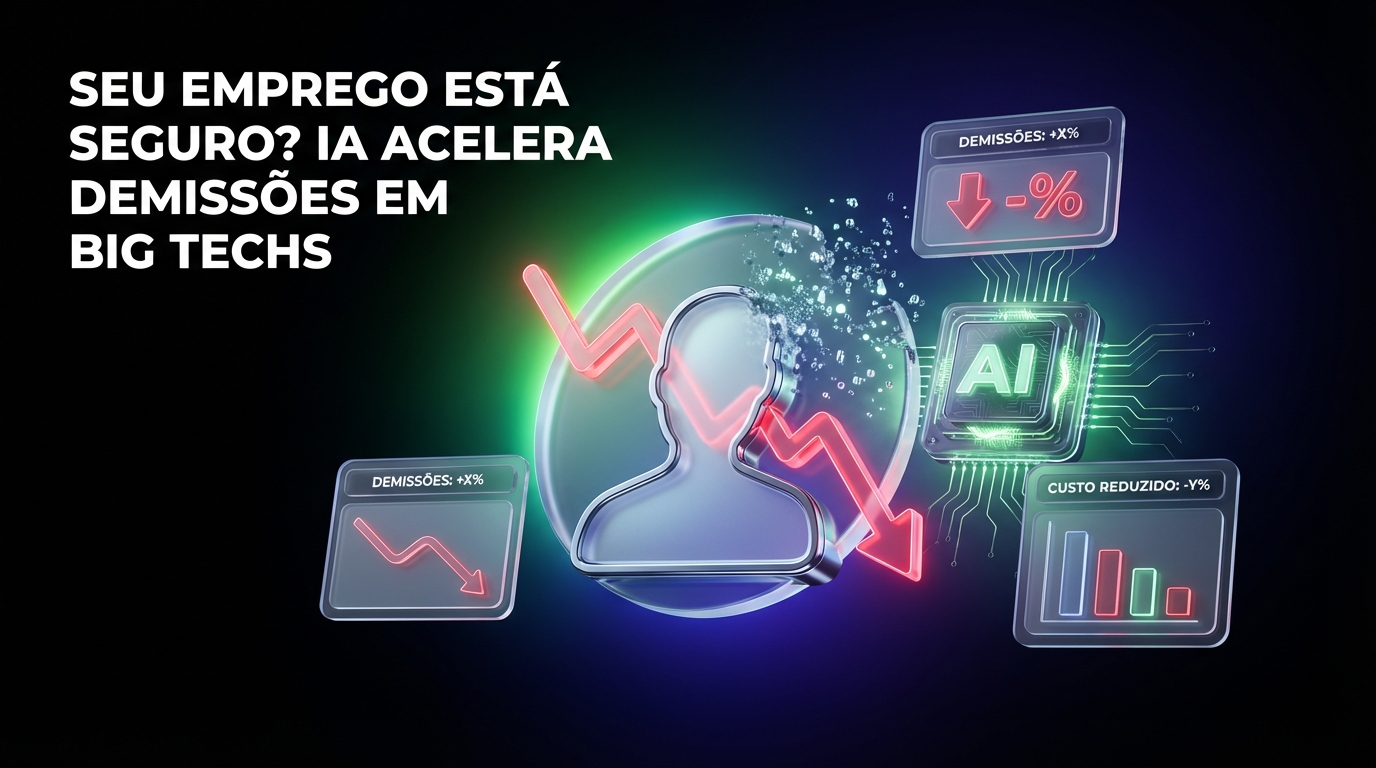
The scenario is clear: Artificial Intelligence, once a distant promise, now redefines productivity and, consequently, the organizational structure of the largest technology companies. Far from being just a “tool,” AI emerges as a transformative agent that catalyzes mass layoffs, questioning job stability and demanding a new strategic approach. As an Industrial or Tech Director, the question is not “if” AI will affect your operation, but “how” and “when.”
What Happened
Global reports and pronouncements from Big Tech leaders confirm the trend: generative AI and advanced tools enable “doing more with less.” This is not about a single technology, but an ecosystem of solutions that automate everything from customer service with multimodal chatbots to code and content generation. Companies like Google, Microsoft, and Meta already demonstrate that AI-driven productivity reduces the need for large teams in areas such as technical support, low-complexity software development, digital marketing, and internal operations (NOC, observability).
This dynamic translates into:
- Support and Service Automation: Advanced chatbots and voicebots with realistic voice synthesis absorb most first-level interactions, optimizing call centers.
- Software Development Optimization: AI tools generate tests, documentation, code boilerplate, and correction suggestions, streamlining the demand for large squads.
- Internal Operational Efficiency: AI for log analysis, system monitoring, and incident detection reduces the need for large observability teams.
- Scaled Content Production: Generation of texts, emails, landing pages, posts, and visual assets with minimal human intervention, reducing marketing and content teams.
The Alchemist’s Analysis
The superficiality of the discussion about “AI stealing jobs” hides a deeper transformation. The Alchemist’s perspective reveals that we are not facing a simple automation of repetitive tasks, but a complete reconfiguration of processes and the intrinsic value of work. Generative AI, in its current maturity, allows for the orchestration of workflows that previously required multiple professionals and departments. It’s not just a chatbot that answers, but a system that analyzes data, personalizes responses, executes actions, and learns continuously. It’s not just a code copilot, but a platform that generates, tests, and documents, requiring less supervision in critical stages. Ignoring this systemic capability and focusing only on the isolated “tool” is to underestimate AI’s power as an architect of new operations. The true value of AI lies in its ability to integrate and redefine complete processes, making fragmented functions obsolete, not out of malice, but out of strategic efficiency.
Impact on Operations
The reconfiguration of the job market via AI imposes complex operational dilemmas for technology and industry directors. Firstly, data and AI governance becomes crucial: who is responsible for decisions made by algorithms? How to ensure compliance and avoid biases? Secondly, team orchestration now requires a new leadership profile, focused on empowering humans to collaborate with AI, not compete. This implies massive reskilling and upskilling programs, focused on prompt engineering skills, critical analysis of AI outputs, and, especially, on more complex functions that require human judgment, creativity, and emotional intelligence. Information security also redefines itself: with process automation, new attack vectors and vulnerabilities emerge at the human-machine and machine-machine interface. For operations, the imperative is clear: re-evaluate cost structure, talent allocation, and the automation roadmap, understanding that AI is not just an improvement, but a new operational paradigm that demands agility and adaptability in people and process management.
Conclusion
The AI era in Big Techs is a harbinger of what is to come for the entire market. For the Industrial or Tech Director, this is not a crisis to be avoided, but a strategic opportunity to be mastered. Those who understand AI as a catalyst for redesigning the organization, empowering their teams with the necessary new skills, and integrating technology ethically and efficiently, will not only survive but thrive. It is time to lead the transformation, not be transformed by it.
Don’t wait to be reconfigured. Reconfigure yourself.
Centrato AI is here to help your organization navigate this transition with proven methodologies and cutting-edge strategies. Subscribe to our newsletter for exclusive insights or contact us for strategic consulting and ensure your company stays ahead in this new landscape.