If you think ChatGPT was a revolution, get ready. What we’ve seen so far was just the trailer. The movie starts now.
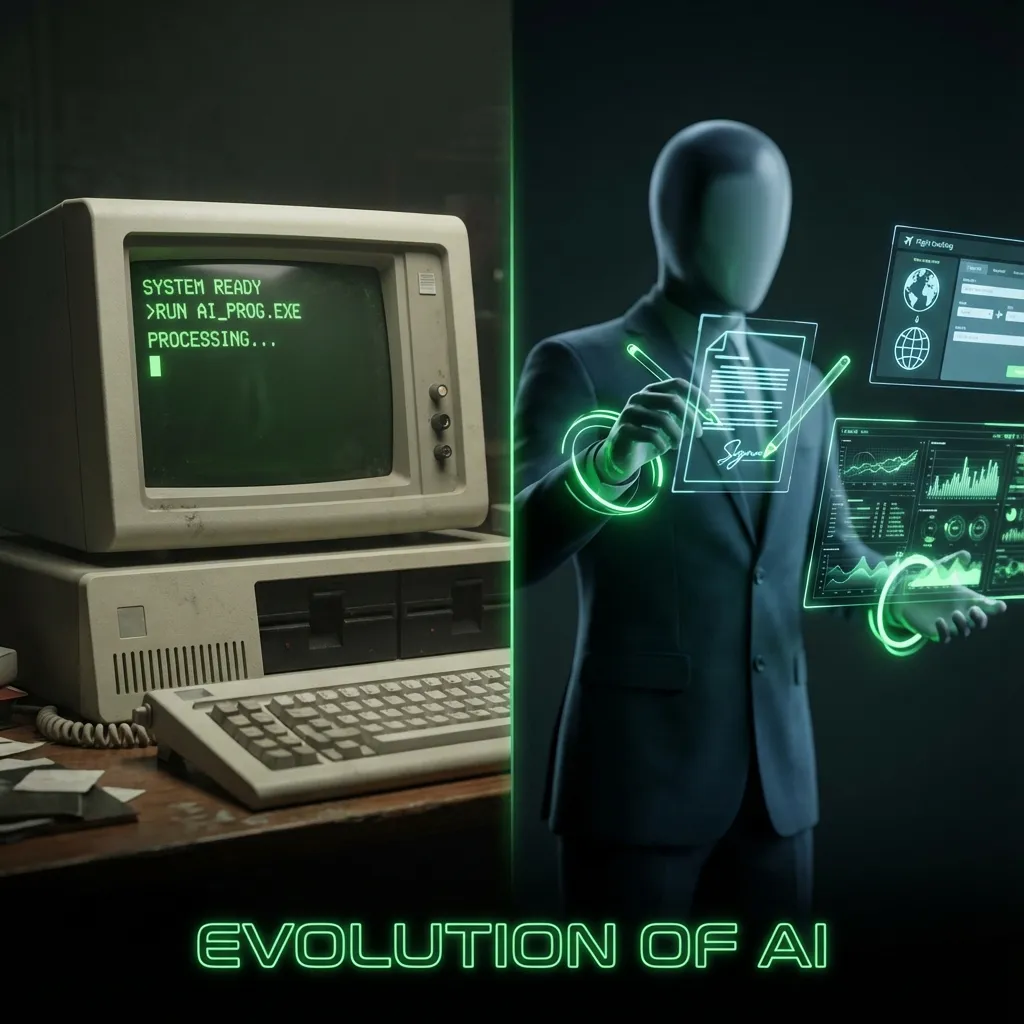
In the last three years, we lived in the Generation Era. We learned to ask the machine to write emails, create images, and summarize texts. But there was a fundamental limitation: AI was an oracle trapped in a text box. It could talk about the world, but it couldn’t touch it.
That ends in 2026. Welcome to the Action Era.
The Evolution of the Species: From LLMs to LAMs
To understand the future, we need to look at the evolutionary pyramid of technology we use here at Centrato R&D:
- Cloud Era (2010s): Ubiquitous connectivity and storage.
- Data Era (2015-2020): Big Data and the raw material of intelligence.
- Generation Era (2022-2025): LLMs (Large Language Models) that process and generate information.
- Action Era (2026+): LAMs (Large Action Models) that execute tasks.
The difference is subtle but tectonic.
- Chatbot (LLM): You ask “How do I buy a ticket to Paris?”. It responds with a tutorial.
- Agent (LAM): You say “I’m going to Paris next week”. It responds “Ticket bought, hotel booked, and meetings rescheduled. Want to see the itinerary?”.
The chatbot is a consultant; the agent is an employee.
What to Expect in 2026?
Imagine waking up two years from now. Your “Personal Agent” is no longer a dumb voice on your phone. It is a fluid operating system that orchestrates your digital life.
The End of the “App Interface”
Today, if you want to order an Uber, order food, and check your balance, you open three different apps. In 2026, LAMs will act as the “universal interface”. You will give the command (voice or text), and the agent will navigate the APIs and interfaces of the services for you. The “app store” as we know it will change radically.
Autonomous Workflows (Agentic Workflows)
In the corporate world, we will see the rise of “synthetic teams”. A sales agent (prospecting leads) will pass the baton to a CRM agent (scheduling demos), who will trigger a legal agent (generating contracts). The human ceases to be the executor of each step to be the supervisor of the flow.
The Real Challenges: Security and Autonomy
With great power comes… well, you know. Giving an AI the ability to click “Buy” or “Delete” requires a level of security we are still building.
- The Action Hallucination Problem: If a chatbot hallucinates, it writes a lie. If an agent hallucinates, it might buy 100 tickets to Alaska. “Human-in-the-loop” mechanisms (human supervision) will be mandatory for critical actions.
- Extreme Privacy: For an agent to be useful, it needs to read your emails, see your calendar, and access your bank. Trust will be the most valuable currency of the next decade.
Conclusion
We are moving from the “playing with chat” phase to the “delegating work” phase. The transition will be turbulent, but inevitable.
The question for your company is no longer “How do we use AI to create content?”, but rather “Which processes can we entrust to an autonomous Agent?”.
The future won’t just talk to you. It will work for you.