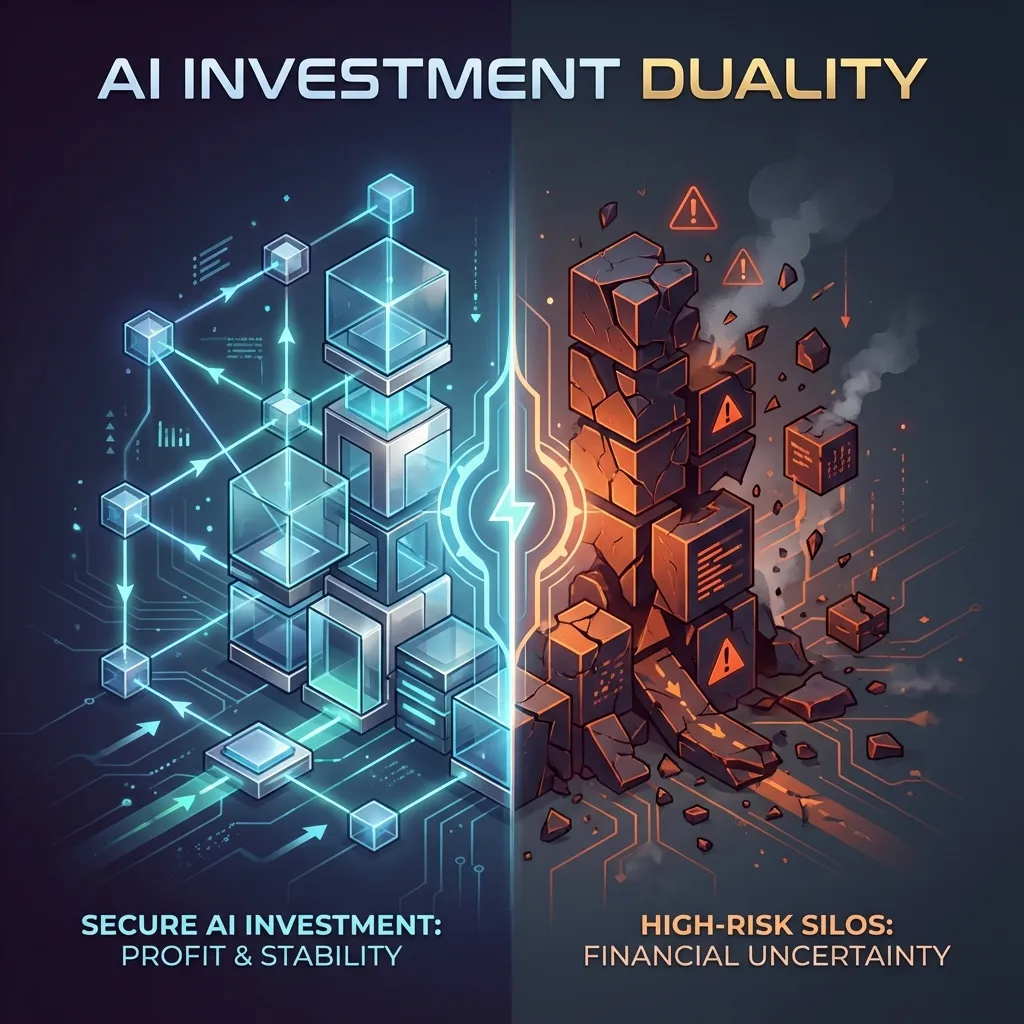

The frantic race for Artificial Intelligence, which promises to redefine productivity and innovation, is now presenting its hidden bill: a global RAM crisis that promises to significantly increase hardware costs in Brazil starting in 2026. Industrial and technology directors need a clear and pragmatic vision to navigate this scenario, which directly impacts budget planning, the supply chain, and competitiveness.
What Happened: Facts in Detail
Since 2023, the prioritization of High Bandwidth Memory (HBM) production—essential for AI servers from giants like NVIDIA and AMD—has diverted a growing share of semiconductor factory capacity. In 2025, approximately 40% of global fab capacity was dedicated to RAM for AI data centers, a dramatic jump from the 15% recorded in 2023. This strategic shift by manufacturers resulted in a severe shortage of DDR5 modules used in notebooks and smartphones, with stocks reduced by up to 50%.
For Brazil, the situation is more delicate. With 95% of RAM consumption dependent on imports from Asian suppliers (Samsung, SK Hynix, Micron) who prioritize billion-dollar contracts with global hyperscalers, the country faces a projected 15-25% price increase as early as the first quarter of 2026. This translates into an estimated additional cost of R$ 5-10 billion for Brazilian retail, raising the price of cell phones by 10-20%, notebooks by 15-30%, and even electric/connected vehicles by 5-10% due to RAM modules in ADAS (Advanced Driver Assistance Systems).
The supply chain is already feeling the impact, with delays of 3-6 months in crucial sectors such as agro (autonomous machinery) and Industry 4.0. National companies like Positivo and Multilaser are already warning about the criticality of their stocks, resorting to price hedging via futures contracts.
The Alchemist’s Analysis: Beyond Reactive Purchasing
For the Alchemist, the RAM crisis is not merely a problem of component shortage. It is evidence that a one-dimensional strategy—simply “buying more hardware”—is a naive and unsustainable approach. Depending on a “single agent” (the hardware commodity market) makes us hostages to the volatility inherent in rapid technological evolution and supply geopolitics.
The future requires a multi-agent and multi-faceted approach. The “agent” here is not an isolated entity, but a strategic dimension that your organization must cultivate simultaneously:
- The Efficiency Agent: Relentless focus on software optimization. Systems that consume less memory through more efficient algorithms, optimized programming languages (Rust, Go), edge computing architectures, and lighter AI models (TensorFlow Lite). Your next software update must also be a hardware efficiency update.
- The Chain Resilience Agent: Beyond being reactive, your supply chain must be proactive. This means exploring long-term contracts, strategic partnerships with suppliers, and perhaps even seeking hardware alternatives (whether through incipient local manufacturing or re-engineering products to use less “noble” chips).
- The Cloud Optimization Agent: The cloud is not a panacea. A hybrid or multi-cloud strategy, with granular management of allocated RAM resources, can mitigate costs. Optimizing your instances, taking advantage of spot instances, and monitoring actual usage can be the difference between a viable AI project and a budgetary nightmare.
Relying on a single plan is like playing with only one “agent” in a multi-dimensional chess game: you will lose the match. The complexity of the world demands an equally complex and strategic response.
Impact on Operations: Strategy, Governance, and Orchestration
This RAM crisis transcends the procurement department, hitting the core of the operations and strategy of any technology-intensive company:
- Cost Governance and Budgeting: IT budgets for 2026 and 2027 will need to be revised. Expansion projects, modernization of technology parks, and even the acquisition of connected vehicle fleets will have higher base costs. It is essential to implement rigorous governance over resource consumption and hardware lifespan.
- Continuity and Innovation Orchestration: Delays in hardware delivery and prohibitive costs can pause or even derail AI and Industry 4.0 projects that depend on robust infrastructure. Orchestration becomes key: prioritizing projects with higher ROI, adapting architectures to be less dependent on high-end RAM, and exploring alternative solutions like edge computing.
- Vulnerability and Technological Sovereignty: Brazil’s dependence on RAM imports exposes a strategic vulnerability. For directors, this means questioning the long-term viability of projects that require commodity hardware and perhaps investing in local R&D for software optimization and system design that mitigates this dependence.
Conclusion: Prepare for the New Paradigm
The era of cheap hardware, treated as an off-the-shelf commodity, is ending. The 2026 RAM crisis is a wake-up call. The companies that will survive and thrive are those that look beyond the unit cost of the component and invest in a multi-agent strategy of optimization, chain resilience, and resource governance. AI is not just a disruptive force in software; it is reshaping the global hardware economy.
It is time to turn this threat into an opportunity to redefine your infrastructure strategy. It is not just about buying, but about optimizing and planning intelligently. Is your operation prepared for this new paradigm?
Want to deepen the discussion on how to shield your infrastructure against future shocks and optimize your technology investments? Subscribe to our newsletter and receive exclusive strategic analyses.