Imagine you are a doctor and a patient walks into your office with a terrible headache. You have two magic tools on your desk:
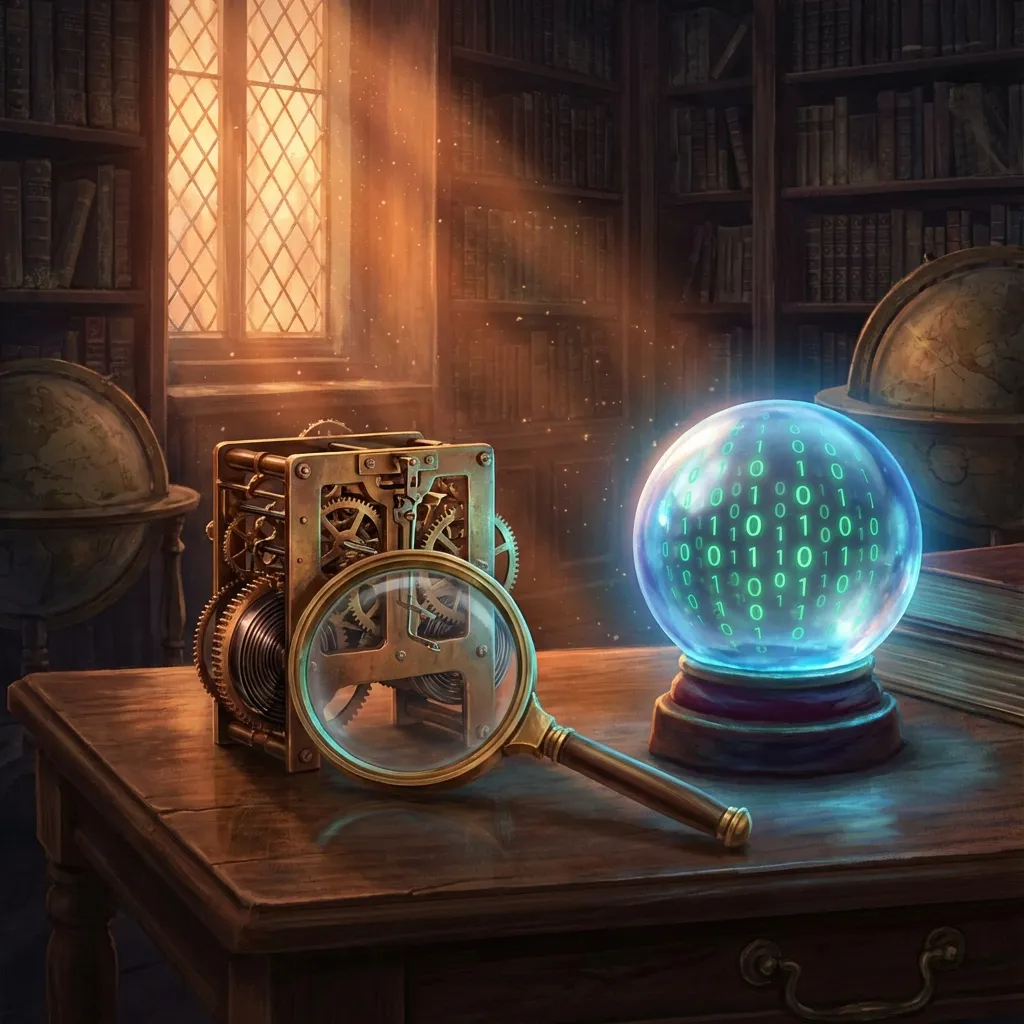
- Sherlock Holmes’ Magnifying Glass: It examines the patient, finds the root cause (stress, lack of glasses, tumor), and explains why the head hurts.
- The Crystal Ball: It doesn’t say the reason, but it says with 99% certainty: “If you take this blue pill, the pain will go away in 20 minutes”.
Which one do you choose? If you want to cure the disease forever, you choose the Magnifying Glass. If you want to solve the problem now, you choose the Crystal Ball.
Welcome to the great battle of Data Science: Inference (The Magnifying Glass) vs. Prediction (The Crystal Ball).
The Map of Inference: The Legacy of Gauss and Bayes
For centuries, science was dominated by the Inference paradigm. From Carl Friedrich Gauss to Thomas Bayes, the goal was always to understand the mechanism.
In inference, the focus is on “Why?”.
- Transparency: We want to see the gears. We want to know that “A causes B”.
- Small Data: If your model is good, you don’t need billions of data points. A well-made sample solves it.
- The Value: It is explanatory. It is used to create public policies, understand consumer behavior, or discover the cause of a disease.
It’s like having a detailed map of the territory. You know where every road is and where it leads.
The Engine of Prediction: The Turing Revolution
In recent decades, with the increase in computing power, the Prediction paradigm (Machine Learning/AI) emerged. Here, the spirit is that of Alan Turing: “Does the machine think? It doesn’t matter, as long as it acts as if it thought.”
In prediction, the focus is on “What?”.
- Black Box: It doesn’t matter much how the neural network reached the conclusion, as long as it gets it right.
- Big Data: The more data, the better. Throw everything in the blender.
- The Value: It is actionable. It is used to recommend movies on Netflix, detect credit card fraud, or drive autonomous cars.
It’s like a GPS that just says “Turn right”. You don’t know why, but you know you’ll get there faster.
The Synthesis: Why do you need both?
The fatal error of modern companies is thinking that Machine Learning (Prediction) killed Statistics (Inference).
If you use only Prediction, you create a dangerous “Black Box”. Your algorithm might deny credit to a person because of their zip code (spurious correlation), and you won’t be able to explain why. This is an ethical and legal risk.
Modern and mature Data Science uses Inference to audit Prediction.
- Use Machine Learning to find complex patterns and make accurate predictions.
- Use Inferential Statistics to open the black box, understand the causal variables, and ensure the model is not just memorizing biases.
Don’t choose between the Magnifying Glass and the Crystal Ball. To see the full reality, you need both.