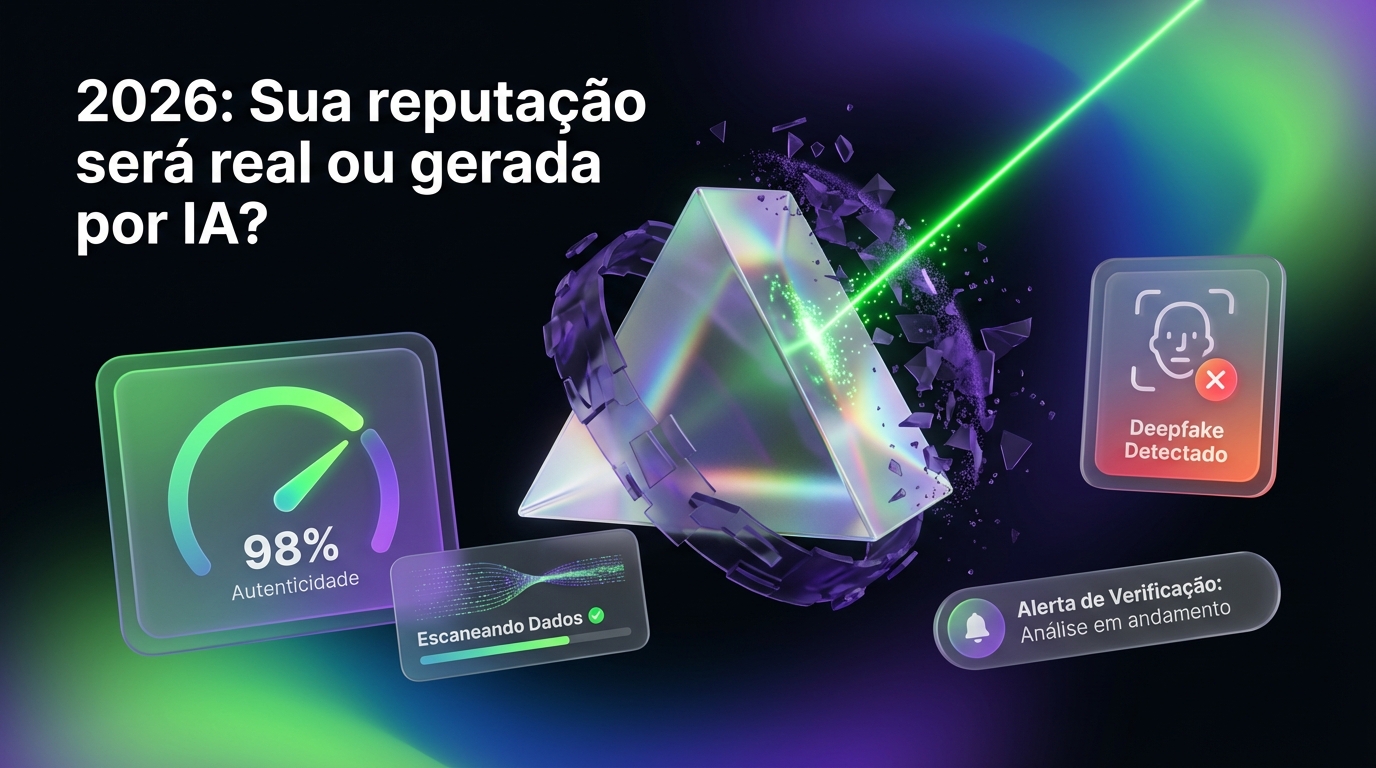
With each electoral cycle, the complexity of the information landscape intensifies. In Brazil, with the 2026 elections on the horizon, the narrative has taken on a new and alarming contour: the possibility that, starting in 2025, the distinction between authentic content and that generated by Artificial Intelligence will become practically impossible for the human eye. This is not just a problem for political marketing; it is a structural challenge that threatens governance, security, and the very perception of reality in all spheres, directly impacting the reputation of brands, leaders, and even democratic stability.
What Happened
Recent, widely debated reports point to a critical technological turning point. In 2025, we may be facing the “last year” in which we can, with reasonable certainty, discern what is real or AI-generated in video, audio, and image. For a country like Brazil – hyperconnected, with massive use of social media and private messaging apps, and still nascent media literacy – this scenario is explosive.
The warning does not come only from local analyses. Organizations like the UN and global think tanks reiterate that AI can amplify inequalities and introduce unprecedented risks of disinformation and political interference, especially in nations with fragile regulatory frameworks. In 2024 and 2025, several countries are already experiencing electoral cycles marked by a proliferation of deepfakes, manipulated videos with candidates’ voices, fake images, and ultra-segmented messaging bots. The cost and technical barrier to creating this type of content have dropped drastically, making it accessible to anyone with a notebook.
In Brazil, factors such as the very high penetration of social media, the recent history of electoral disinformation (2018 and 2022), and extreme political polarization form fertile ground for this threat. A perfectly convincing fake video can go viral in millions of groups in hours, causing irreversible reputational damage before any fact-checking can react.
The Alchemist’s Analysis
We are not just talking about fake news or common rumors. The rise of generative AI marks an inflection point in the battle for truth. If before the challenge was to discern between true and false, now it is to authenticate the very origin of digital reality. What was once a matter of “I saw it, I believe it” transforms into “I saw it, but is it real?”.
What makes this threat qualitatively different and deeper is its democratization and its capacity for perfect mimicry. It is no longer just sophisticated state actors who can create deceptive content; the technology to clone voices, replicate facial expressions, and generate entire videos is in anyone’s hands. This means that defense cannot be merely reactive; it needs to be proactive and systemic, focused on origin verification and cryptographic signatures, rather than just superficial content analysis.
In an environment where visual or auditory “evidence” loses its intrinsic validity, trust shifts from perception to authentication infrastructure. The “analysis of an agent” (human or simple tool) becomes insufficient. We need orchestrated systems that act as “counter-alchemists”, capable of deciphering and deconstructing the illusion generated by AI, protecting the integrity of information at a fundamental level.
Impact on Operations
This new reality demands a profound strategic recalibration for industrial and technology directors, whose operations and reputation depend on clarity and trust.
- Reputation Security: Traditional cybersecurity is not enough. It is imperative to implement brand safety strategies that include active monitoring of synthetic content. Rapid response protocols for deepfake attacks against company executives or spokespersons are crucial. The ability to prove the authenticity of one’s own communications becomes a strategic asset.
- AI and Information Governance: Companies need to develop robust internal policies for the use of AI in communication, marketing, and product development. This includes clear ethical guidelines, human review processes for sensitive AI-generated content, and compliance with future regulations on transparency and authenticity. Data governance extends to the governance of information veracity.
- Response and Proactivity Orchestration: Defense against AI disinformation is not an isolated task, but a continuous orchestration among communication, legal, IT, and public relations teams. This implies not only detection tools (counter-AI) but also ethical “offensive AI” strategies – such as using AI itself to monitor narratives, anticipate risks, and effectively disseminate authentic content. Preparation for 2026 requires building an AI and counter-AI “laboratory,” with dedicated teams and strategic partnerships.
Conclusion
The rise of generative AI and the imminent challenge of the 2026 elections in Brazil are not just “another technology agenda item”; they represent a fundamental redefinition of what reality and trust mean in the digital environment. For industrial and technology directors, ignoring this transformation is to leave their organization’s reputation and the integrity of its operations at the mercy of invisible manipulations.
The future demands more than vigilance; it demands proactivity, investment in authentication infrastructure, and a deep understanding of the alchemical dynamic between AI and human perception. Centrato AI is prepared to guide your company through this new era, transforming threat into strategic opportunity. Connect with us to explore methodologies that will shield your reputation in a post-truth world.