The speed of innovation in Artificial Intelligence is undeniable, but the same euphoria that drives the massive adoption of advanced models masks an inconvenient truth: security. Many industrial and technology leaders, seduced by the promise of efficiency and new capabilities, have “blindly” relied on AI solutions provided by the largest companies in the sector. However, a recent study by the Future of Life Institute, published by Fast Company Brasil in December 2025, raises a red flag: none of the evaluated Big Techs adopt sufficient safeguards to prevent loss of control, malicious use, or catastrophic consequences.
What Happened
The report analyzed eight of the largest global AI developers, and its conclusion is alarming: the sector, which moves hundreds of billions of dollars, does not keep pace with risk governance. In practical terms, this means that despite stratospheric investments and public declarations of responsibility, concrete, auditable, and independent oversight mechanisms are lacking. Critical points such as transparency, pre-launch security testing (red teaming robust), shutdown or control capabilities, clear policies against offensive military use and cyberattacks, and channels for reporting abuses were largely deficient. Most companies are still in the early stages of maturity in security and responsibility.
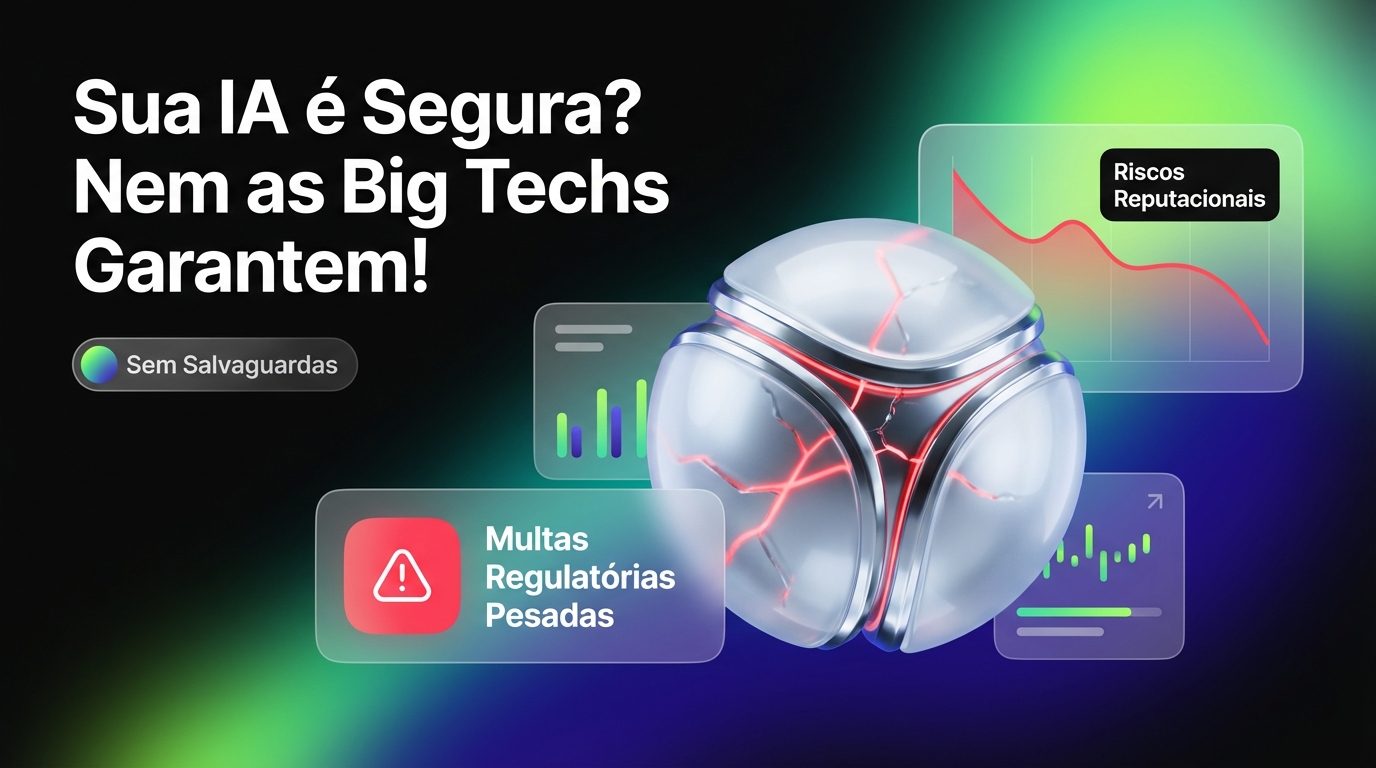
For any organization integrating these models into critical processes – be it credit granting in banks, fraud detection in insurance companies, patient screening in healthcare, or automated decisions in industry – this gap represents a latent risk. If Big Techs themselves cannot demonstrate full control over their systems, reliance on their “black boxes” exposes their operations to errors, leaks, biases, cyberattacks, and uncontrollable decisions, with serious reputational, regulatory, and operational implications.
The Alchemist’s Analysis
This scenario of structural vulnerability in Big Techs is not just a “policy” failure; it’s an architectural failure. The current AI model, even at its peaks of advancement, is paradoxically centralized in its control (or lack thereof), yet widely distributed in its potential impact. The report highlights that trust placed in a single intelligent agent or monolithic system, however powerful, is a dangerous gamble.
At Centrato AI, we advocate for the vision of multi-agent systems as the future of AI security and resilience. A single agent, by its nature, represents a single point of failure. It’s like entrusting the security of an entire city to a single guard. It might be efficient, but it is inherently fragile. An isolated agent is, in practice, a dangerous toy in the hands of the unknown when scaled for critical responsibilities. It lacks the redundancy, cross-validation, and self-regulation capabilities that an ecosystem of multiple agents, working in concert and with distributed governance mechanisms, can offer.
True AI security does not lie in a super-agent that controls everything, but in an intelligent orchestration of interdependent agents, each with clear responsibilities and limits, and with veto and audit mechanisms embedded in their own architecture. This is the path to transform the risks highlighted by the study into opportunities to build genuinely robust and auditable AI systems, where governance is an intrinsic part of the design, not a fragile attachment.
Impact on Operations
For the industrial or technology director, the practical implications of this study are direct and urgent:
-
Operational Security: Reliance on AI models with insufficient safeguards exposes critical processes to unexpected behaviors, exploitation by attackers, and biased decisions. This can result in production shutdowns, financial losses, and compromised physical security of employees and assets.
-
Governance and Compliance: The chance of regulatory tightening increases exponentially. Expect more demands for risk reports, independent audits, security tests, and detailed documentation. This not only impacts project timelines and costs but also elevates the individual responsibility of directors and board members, who can be held accountable for uncontrolled “automated decisions.”
-
Orchestration and Control: It is imperative to review contracts with AI providers, demanding clear liability clauses and objective evidence of security. Internally, the pressure for rapid adoption must be mitigated by rigorous AI usage policies, especially with sensitive data, and by the creation of internal AI risk committees, involving IT, legal, compliance, and business, to map and classify the criticality level of each use.
Even “non-technical” professionals in the company who deal with strategic decisions need to understand that poorly governed AI can lead to lawsuits, heavy fines, customer loss, and lasting image crises. AI-generated content, for example, can carry legal and reputational risks if there is no rigorous control.
Conclusion
The Future of Life Institute’s warning is not an apocalyptic prediction, but a pragmatic call to action. AI is already an intrinsic part of our operations, and naivety regarding its security is a luxury no company can afford. Transforming this warning into strategic action means going beyond reactive policies.
It’s time to design security, not just apply it. Centrato AI advocates for building resilient, auditable, and controllable AI ecosystems through a multi-agent architecture, where trust is distributed and verified, not presumed. If your organization seeks to navigate this complex scenario with intelligence and robustness, do not settle for safeguards that even Big Techs cannot guarantee.
Transform the warning into strategy. Speak with Centrato AI and discover how our methodology can strengthen your AI’s governance and security.